Tent of Many Voices: 04090601TMB
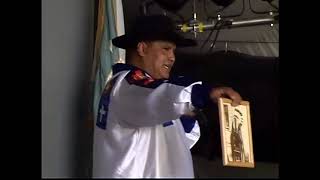
genten welcome to the tent of many voices this tent is part of a traveling exhibit that has been following the Lewis and Clark Trail since January of 2003 set up in cities towns reservations all along the trail uh we have followed it all the way from the East St Louis up to the Mandan Villages and to the Pacific Ocean and now we're on the return Journey heading back East just like Lewis and Clark were 200 years ago Lewis and Clark made this journey in three years time period we'll be making it as well in that same time frame but they would not have been able to complete their Journey had they not had the help and assistance of many of the different Native Americans that they met along the way in this tent of many voices we bring people in from different backgrounds different walks of life to tell their side of the Lewis and Clark Story or tell the side of the Native Americans and what their lives were like before Lewis and Clark and after Lewis and Clark so it is with great pleasure today that I introduce to you our next guest this is Terry Courtney and he's going to be talking about fishing along the great Columbia River so let's please make Terry welcome thank you very much uh if if any of you in the back room cannot hear me uh sometimes my voice gets real low so just raise your hand I'd really appreciate it I know you know it's not fun to go somewhere and not understand or hear people I am the oldest of seven children I have one brother Five Sisters my ancestry starts here on the Columbia River the Wasco Little Village up here by Lone Pine Indian village by the Dells and where the Dell's dam is there's still some old structures there that where people had built modern type buildings and now they're dilapidated but that's where my ancestry starts from now we've been moved Inland uh to the waren Springs Indian Reservation which is about 90 miles or an hour and a half Inland it's uh well I guess I need to start off with uh took the wig in my language is good day Ki NAA I'm just asking how are you I am fine IM always which means my name is always which is little brother the name I adopted from my grandpa and my grandfather I thought so much of it that I put it on my license plate and and so now I drive around in the countryside and I have have my own name on my own vehicle it's kind of warm up here so it's kind of kind of taking my mind off of where I need to be and and what I need what I need to cover um years ago most of the people on the Columbia River never really traveled away from the river when the fish started running we needed to catch each and every fish that we could but even though there was an abundance of salmon we had people in our tribe that would tell us when we had enough fish years ago there was between 9 and 16 million fish that run the Columbia River but even then we had bad times just as much as we had the good times and the way our people looked at it the way I look at it as a a person of vision is every time you have a bad time the Creator is testing you to see what you're going to do the fish are low the water's low the huckleberries aren't there very much so the Creator is putting you to a to I believe put us to a test how do we combined as a tribe or as a clan to harvest and take only what we need then the rewards come every so often I was raised in a boarding school and uh to well I lived way up in the woods with my mom and dad and uh one day this big black Buick drives up and this lady all dressed in white which is a I thought was a nurse got out and was talking to my parents and the next thing I knew I was I was 5 years old and I was riding down to worm Springs to a boarding school so I never got to see my parents for about about three years and it was it was quite different because in the boarding school we had to to get up and then we had to all wash and get cleaned up all by a certain time and then we had to line up outside and be in and actually be inspected while you're five six years old and on up to the eighth grade so yeah I never I never spoke any of my language I did not have long hair so in a way I was blessed there I I wasn't picked on because I I did I only knew English but my friends around me that knew knew the language were forbidden to talk it and there were consequences the same as there was consequences when we were learning things to like to read and write if we consistently didn't get it right then they would kind of tap you on the hands right here and if you persist if they thought you persisted on being nonconformist and they would turn your hands over and and uh lay it across your hands so a lot of our elders grew up that grew through the system before I completed it did not ever want to be called an Indian or didn't want to be known as Indian because there was too much heartache with it so even now you run into some of the tribal people that are seem to be real hard noosed and everything and it's it's something that you know is just not passed out of the mind and then it passed on this is what some of the kids have learned but I was fortunate enough to have my dad come in from from outside our culture he was from Alaska he came down into tahola area and was raised raised there passed among missionaries for probably four or five families before he's adopted so the first thing they did is after they got him they asked him when was his birthday and he just said what's a birthday so they thought you're not serious and they said well I don't know what a birthday is so they said well that's the day you were born and so we got you on September the 17th you're you're about this old so September the 17th 19 12 is your birthday and the preacher and his wife there were English their last name was ellworth so they said well you're not really our son so we're going to pick you out a name so they went down the list and Y and behold here's Courtney so that's how we got our name uh and my dad uh was raised off the reserv ation and so when he met my mother we no longer even though we lived on reservation we no longer had ties to the language we didn't have ties to to the beliefs and stuff that we had but the one thing my dad did teach me was to when I we mainly were fishermen I mean not not as you see a net but a fly fisherman and so that's all my dad knew so he always events he told told me as I got older I was catching too many fish and so did my grandpa so he said you need to take only what you need so if you go down and you catch fish for a week for the week you're no longer going to fish so you have to string your fishing out so that's that was my first knowledge of of having to deal with anything in nature I'd like to share with you now uh years before then when uh our people first lived on the river we depended on the salmon steel head coo whatever was in that River at time the fishing methods uh vary greatly from most of the stuff that you you see now uh the Water the Columbia River as you now see it wasn't the way it is was then it was a series of whole bunch of different Rapids turbulent boiling water in a lot of spots and this was about the only spot that their tribes could really fish because when the river was wide in spots the fish were all over so was the channels narrowed up and the water became turbulent and rough and this was where the fish congre at it and they would pull up in holes and some would go straight on through and some would go around and rest and so our people would had different methods of fishing for the salmon and uh before we get too much into that you probably see the fiber on this and you'll say that that is really thick how can you catch a salmon with this but most of our Nets and stuff were made out of fibers this is in this would have been the inner bark of Cedar and the fine mesh on the Nets their finer would have been out of dog bang uh Nettles and there's some other materials that are long forgotten or that our people didn't want to share with other tribal members so it just disappeared with the coming of livestock onto the reservations and uh not people not having enough Savvy to to uh have enough crops to feed the feed the wildlife then they naturally ate everything in sight so a lot of a lot of things that we knew medicines fibers disappeared this is just a this is just a little baget I don't have a dip net which would be about this long and fit on a hoop this size to about like this and each one of these strands the women would go out and they would Harvest they would Harvest these plants some of them are this short and some are as tall as I am they take and they they break the plant up and they use uh stones and until they get the fiber and then they peel them back and then they take all the they would take all the fiber and if you put all strands together and they would they would spin them like this until they got to the end to be frayed so then you put another another one on here and you put this over and uh if you wanted them larger then you left them at a small small diameter and if you wanted them larger you just took two or three whatever you needed and they did the same thing so to make a dip net I would estimate that it would take uh probably about two lengths of a football field for these women to spin this twine so that the men could weave the Nets and usually the men were the only ones that W the Nets and the women did as they do now they did most of the work they spent all the twine they were always consistently working on that plus they had to take care of the children then when the salmon came the men would bring the salmon to the women and they would cut it and they would hang it to dry most of it would you know there was no refrigerator or anything so most of it had to be dried so it was all Flay and laid out a dried so they were continuously hanging fish cutting them hanging them and uh the way I understood it is nothing was ever wasted in The Villages they had dogs so they would take care of all and dry all the meat the backbones the heads and the heads after they they dried them laid out they were called Muk each strip of dried jerky was called cage that's like jerky and uh the backbone I I I don't know the words for that but they had dried skins too and after they got through that they ate the eggs and I I I never wanted to eat the eggs because they just you know they look slimy they pretty color but they didn't smell good so you know to kind of get off the subject a little bit one year um my little daughter was sitting there and she's a year and a half old so we catch the fall salmon and the fall salmon have like marbles for eggs because they're so big whereas the the spring salmon they have skin and the eggs are real small so they're together so I'm looking at these eggs I'm looking at my daughter and I thought I'm going to see what she's going to do so I rolled out about 10 or 12 and she starts eating them and I put some more on there and she started eating them so I thought well if she can eat them so can I so I ate it and it really isn't any different than a boiled egg which to me was surprising it's just the thought of it and now we get back to where the the women doing the work and after the women did this and uh certain women were picked out of the tribe and they would go and travel up to about 6 months away from away from each Village and Clans and they would make this big circle going up into the like like uh we take the May sometime the celery comes out and they go out and they harvest the celery and that's only edible during the season they can't be can't be dried or anything but then they go and they start digging Roots there's about five or six different types of roots there's some that that are around I think they kind of call them wado down here that are down in the will Amit River back in uh our country is called looks and you have dck which is about this long and about that wide looks like a carrot they're all about six to8 8 in underneath the ground then you have pahi and it looks it's a little root system a plant that only sticks this high of the ground and you only dig down possibly maybe an inch and they they fan out but they're they're in a rock patch so all these can be dried so the some of these women would go out and they would pick the roots and they would dry them and then from there they would make it into the higher country where they had the medicine stuff Camas and and other stuff then they from there they hid into huckleberries and once they were into the huckleberries and they dried them up there by building fires and uh having finding rotten logs and they would they would sh uh scoop them out a certain way this is what I was told by one of my friend scoop them out a certain way then the uh one woman would be in charge and they would put a bunch of huckleberries out and then every every half hour they would turn the berries and turn the berries so that's how they they took care of everything so when you came back a big basket of huckleberries like this might be just a little little conglomeration like this and I knew that they had our people long ago had to have Foods where you could travel because uh uh as as the tribes moved through different areas some of the people didn't like you and they were saying this is my country so you didn't dare build a fire so you had to be able to travel through different parts of the country and I think uh through this whole United States as we know it I think all the tribes had their own their own version of what they call pimkin pimkin the base on there's two different types of bases I guess there could be three now but they had one that was they ground up the salmon and that was mixed with with uh uh all the berries and The Roots and stuff and then if you wanted the meat then you took elk or you took the deer meat and you ground it up and put it into them but the key to all this I've been hearing two different versions and for years I've always wanted to try and make some but no one would give me the ingredient so finally three years ago up River they're talking talking about how essential the steel head is to the tribal people because they cut the underbelly off and then they hang it out and they catch it and dry it and this is what they mix with the with the pimkin and that just that so won become rancid and so just lately I read another book and it says they take the oil out of a chinook so it's kind of a I'd hate to Tri in a it then the other one is I say three is because now you have people that are into to non meats or anything so you could possibly make that into all vegetable dish if you have any questions along the way and don't understand or or want to know something just don't be afraid to hold up your hand or say excuse me and uh so as our as our women folk travel then the men Folk it was up to them to scr the shores and and uh meand are out a little bit looking for whatever deer they could find that were that would be near the river because the elk were up in the higher country so that's why our people used the uh columia River and the natural resource out of it which would be the fish that was our currency so we needed buffalo buffalo highs and certain times of the year people would bring in from the from the Doos bring in the Buffalo hies bring in the obsidian that we needed and then tail your shells off the coast so there's various Commodities that were traded up and down the river and I'm pretty sure a lot of you have heard of salila Falls which was the the last of the great trading centers but it it was not the biggest it was the last is the only reason you hear about it and people saying it was the biggest but it was not the biggest up here by the Dells there's a place called cyhawk where horse Steep Lake is that was known as probably the one of the biggest trading centers and if you look at the Gorge as you're going up it's all steep walls you get up to the DS and it opens up so it was easier for tribes to come in and and Venture and trade right there so that was why most of the big trading was done up River until you got to the mouth of the coli River and then there is where uh the main tribe there was a chunuk nation and uh as you come up you have different different uh Clans and bands of tribal people like in this area uh see it's a River Bridge of the Gods this was owned and fished by the dog River tribe and I think you I don't know if you been aware of when loose and Clark came down they they dumped over a few times so they pulled out above the Cascade Rapids and went around and put their boats on the side and it ate all all their equipment out you know to dry what they didn't know well the Indians came along and Indians start picking up stuff and walked off and so they were hey what's going on you know the people stealing from us right in daylight you know but the dog River people owned this area they made the trail so you had to pay a fee the same as you would have to come you know pay over to come over this bridge so there was a kind of a big M uh misunderstanding and and unfortunately it was in black and white saying that you know they were thieves and stuff but uh and of course you know the some some tribes they if they saw something they like then you you better keep your your hand or an eye on it pretty close because it could tend to disappear once in a while but most of time if our people saw something they like they would try to trade for it and so I always looked at the uh trading back into I know one of the uh necklaces was made on the coast out here by the ha Indians and made it up to Columbia and it event she made it back to Milwaukee Wisconsin so I always looked at it as the the tribes had internet first it was just a lot slower um and uh I also have a name that was given to me uh in the honor of my uh grandfather and it is tea tea a cold but right now I don't use it too much because there's a little bit of conflict with an another member of our tribe so I'll I'll take on two other two other names and then I will take my grandfather's name still which I which I'm entitled to but the names are given to to all the children as they're growing up so that you'll always remember your ancestors so even now when I went into the service I came back out I didn't know some of these kids and I'd only been gone for two years so I'd asked them their name and I didn't recognize their last name so I'd say well who's your mother I who's your grandmother then I knew who they were so to us it was like this is your this is another way to trace your DNA um trying to think here back to when we're grown up along the river now I'm not sure how the female part interacted because I think the daughters as they grew up there were just taken right in to the to the all the work you know the hard work and everything but I know it for a while until a certain age the boys and girls all played together but then there was a certain time where um Boyhood kind of died and they had they used to have a ceremony for when you when you were a young man you were no longer a child anymore they also had a ceremony for honoring the girls into Womanhood and this was a big thing you know it was nothing to be ashamed of they had they had uh rights that they that they did for them and it was astounding to to find out that uh some of the I don't know if it's some of the tribes or all the tribes but you have uh uh right of fertility and this is actually where they carved the stone out of a excuse me but they carved a stone into a penis and this is a right for uh for fertility I don't know how that went on but to me it was It was kind of different to see some of these things and you I mean the way we're raised now you're kind of halfway ashamed to see some of this stuff or to even talk about it and as as a young boy if I'd have been growing up in the village when I start turning to a young man the first thing I would have to do is start learning how to make the knots to weave a net and you were during the winter we didn't fish we didn't hunt everything was away from us everything was hibernated and so the tribes everywhere always looked at as a winner and stuff is when you when you're a family you spend time together you teach each other by Word of Mouth you teach each other your language you teach each other the rights and stuff if you're going to work on Nets you want to work on them then if you're working on your hunting gear you work on them then we were not supposed to as the salmon is running we're not supposed to be working on making I mean we're supposed to be ready because each and every fish that you caught made a difference so as a young man would make they would have to make say four or five Ines or so then as you got older then they got more and more but probably by the time you'd you been working on for two or three years you had to be able to make a dip net and the net material was fairly strong then so you you didn't have to work on too many but after the coming of the white man please don't take me wrong at the coming of the white man then the tribes were pushed off of places where the natural material is livestock came down if they weren't fed right then they ate everything in sight then a National Force comes along and you can't go there and harvest anything so our people start turning to twine you go to store twine so you know you catch two three fish they make a big hole in it so our people the boys as they were uh growing up in the 50s they were always constantly making Nets because of the material that they had to work with and finally they came up with h with nylon twine and that was much better but it wasn't treated so it tend to be very slick so it was a trial and error of how to make a net to make different different types of knot so that the when the fish H in they wouldn't split open the mesh and go right on through so even nowadays we have a regular Mash knot and a half double knot double knot and a half and the double knot and a half comes in really handy because that's when people started working a monofil line so it's the fish couldn't be able to see the Nets and stuff on the the boy the well all the all the children in the family when you're growing up we have laws that are Unwritten and those we had to learn word for word and sometimes as children are say you're a teen you're 19 20 years old and grandfather starts off with you know when someone dies on the river and the kids will say grandpa we've heard it a million times and he'll he'll say but you haven't heard it enough because when I pass away you have to be able to tell your children the same thing and one of the reasons they didn't write it down is because because you cannot amend it you cannot add an amendment to an unwritten law now people can even nowadays are people in the tribe you know it's not written down but people don't really know so they they got an idea so then it's up to myself or some other Elders that know their laws that are supposed to be which I did not know until I was about 36 year years old and I started doing doing this fishing and doing hunting because up until then I had never been involved in any of my treaty stuff I just went to watch the dancing and the celebrations and there was no power I was in I went to the ruse feast and everything and I didn't speak the language and they talked their native language so I had no idea what they were saying or what they were doing and as I got older while the elders started realizing that there was a gap the language wasn't any good what they knew because a lot of the young people didn't know what they were talking about uh in honor of the uh fish when we were what we're supposed to still do is when the fish comes up well let me back up some years ago when the river was Wild and the water was turbulent we could drink out of it anywhere and the main reason being that as the water spilled down it turbulated and so all the all the stuff that was impurities or any solids that were in the water would naturally float to the top so even nowadays I know I I've tried to share with people if you're out rafting somewhere you lose your water you don't have any water find some tumbling water you take your cup and you turn it upside down put it below the water surface about a foot turn it over and swish it a little bit you bring it up because you have the more pure water underneath as you come up to the top everything flows off so you can you can get your water that way now when the Waters narrowed some fish went through and some came up and were washed back down some came up to the falls and I think you've all seen the picture where the bear is standing out there waiting for the for the fish for a demonstration a lot of people or a lot of our old people would take and they would have a a net assembly with this is a waterfall right here so the net would be shoved out here fish jumping in you know there's 9 million fish so there's no problem with getting a fish so when a fish two or three fish in then they pull it back in and on the other end of this there was another net so when you pull this one in club took the fish out you were pushing it back and forth so you always had a had a net in the water at this level and so that was one of the ways that back in the old days that they got them plus they uh they did a a dip net system I guess I'll have to kind of back up here have do you all know what a dip net is dip dip when they dipping just sweeping the water anyway since I got this here I was going to make it into a set net but I realized that usually this is usually a fur Pole Douglas fur white fur tends to to break and even though this is a tubing it has about the same principle but you usually need to find where the where the fish come up because most of your fish are going to be out in the middle of the river and that's the plan that's that's how nature takes care of herself make sure that all the beig all the good fish are going up and then you have the weaker strand which comes in comes in along the banks so you take and you you dip the water come out like this and when you hit the end and you raise up come over plunge it in real quick and and then come down and as you're coming down you there' be rocks and stuff so you have to eventually you you'll find out where all the rocks are so you bring this up over the water you come in like this and as you're coming down like this and all a sudden it'll Tremor well the fish has got in there and it's trying to get out so you just jerk up real quick and the old ones didn't didn't have this but they had a a real long a real long n on them and they were probably three times as big as this and they were all wooden so they pull them up and then whack them and then get them out and then start scooping again nowadays they have uh metal hoops and uh when you catch this salmon now most of them you jerk real quick and this will collapse down into a bag so your fish is hung out right here so as you're sweeping the water and coming down through here and sometimes you can feel you can feel it you can feel when you miss this it'll slide right right right by them and you come back up and you come down and then when they get in there sometimes if you're not quick enough just because you have a net you know they won't be in there oh the other thing too is you the fish hear that and they're gone they'll turn and they're going down the river see this more gentle it's that's more like wood so wood was always recognized as being a lot better but became became more work and harder to get this is what I would go through even if I was on a platform I come down enough enough time to I'm a night fisherman and our tribe years ago used to never never hardly fish at night because it was dangerous and there was so many fish you could get what you could always get what you wanted so a set net you just take this over plunge it into the water and you have a what they call a tie down rope so you move this down you just make sure this is tight and you just stand on it and so the water tubulates and Bone bounces and it moves and stuff so you have to get used to I like putting my hand on it because if a fish hits the hoop on the outside I can feel I can feel sometimes feel a spin or if it hits straight onto the pole because you can hear a thud but you don't you it's hard to tell because of the the water whether the salmon has hit the hoop or has hit the pole so if it hits a pole you feel you can feel it through here and the nothing down here so the reason they they call this a set net is because as the water rises you'll have to move up with it and sometimes you have to to move in a straight line either way so that's why they these trigger strings are usually like this and we usually just try a twig on here real quick like that and when you do get a fish and you pull it up you get it here on the deck and just like this you have to watch for the club and everything you get it out here and then you always got to make sure that you put it up here because that fish is if you put it down here that fish is out and more more than likely at night he's going to be gone you put it out here and then you look for your club and I usually spin the and then try to try to hit the salmon between the right between the eyes on top of his head and the reason I I don't use a flashlight we don't have very many fishing places but we have more and more fishermen so if I build a platform and I leave or I do something I have people coming down and bother me so if they don't know how much fish I'm catching the chances are they're not going to be down bothering my fishing place so in the dark the salmon is a streak like this and it's narrow and it gets wide to the head so I know where the head is so you just reach down there and push down on it and then you smack him gently and then when he just shivering then you can you can feel up on the head and and I've never hit myself in the in the hand then you have to pull the salmon out and lot of as the fish are running I usually just slide the fish to the back of the platform take this and push it in real quick take this underneath a 2x4 and then you take it around and lash it down and no you have to reach out here to find the string in the dark okay it's working real good nothing is hit so then you get up go back put your fish back in the in the box and come over and and uh I use a uh I'll have a 2x4 out here so that if the fish does bounce he won't go off the edge because sometimes you're trying to find a club and you get over here and you get too far over this one if he drops over the edge and you have to bring him up over the lumber and the lumber will catch on the net and you have problem s and I also have a 2x4 on this side and I put a flashlight right here in a flashlight in case I need it and there's a what's missing on this is a a setting that we have one wire that comes to the front here another one that will come about from right here to this side of the hoop and it comes underneath here it's called a tieback so when you throw it over so when you're fishing at night you have to I usually we grab the pole and stuff and then you have to search for the trigger string put it in your hand like this so that when you throw it over it's it doesn't catch you on the feet or it doesn't catch you behind the back of the head because it will and when you put it over most of us just put it over and you you push it hard so if this thing comes over the top of your head you could you could go in and we're all tied with with uh safety ropes and so a tieback is is really essential because uh as the salmon come up they Glide along the Rocks that's her guide path and the water's spilling and boiling and turbul so when they come on here like this me and so if fish aren't hitting in there I have to pull it up and then I have to untie everything actually everything water comes over here then I have to get out on this plank and I have to reach out out there and lengthen or shorten the wire then I come over here and then I have to take this one back it looks kind of dangerous when I first started this old guy told me you know all this stuff and I'm standing there and the only thing I've ever done is f fish you know you get out there and and here's this platform sitting out there above the water get get on it oh man you've heard people say I wouldn't get on that thing for it save my life so I'm thinking holy mackerel you know I go out there and I'm going like that and it's so I finally got off and looked underneath and there's a lot of lumber underneath there you know that we so wouldn't pull forward rocks on the back and so I get out there and push a net over and the water takes it like this whoa you know no one told me the water was going to be that vicious you know so and then I hit another one where they said just push it over you know and and it'll set in place and I put right here and I'm trying to grab the thing and the water keeps pushing this thing up and down and you're trying to reach underneath you know and so it can be quite an experience I just I just finished this this is this one is a just out of uh store twine they call it I don't know if you I don't know if you remember store twine back when I was growing up you ordered groceries and you put them in a box and when the box is overflowing they put the lid the lid staying straight up they got this grocery twine and they wrapped around two or three times and tied it and so that's what this is is just is mainly for a for a demo it fits on about a about a 12T hoop which is probably about like this we can fish with Hoops up to on or I fish on a dute river in Central Oregon uh we we can use up to 16t hoop which means I could walk over and I could just go like this and walk into the to the NIT to the hoop and some of the some of the uh this is one where we fish up by the walls that made for a 16t 16 ft hoop and it is tapered I worked 8 to five and when I go down a fish I I would miss fish so I kept thinking how am I going to make this better so I got this how to make a net book even though my uncle had taught me how to make one and so I thought I'm going I'm going to get greedy so I made the net real big on the bottom so pull them here and and I can see the fish going down the River it was so big the fish had turn around and come out so then I went back and I made so I made it tapered a little bit so then when the fish come in they hit the back then they're there're they're hooked up for a split second so I was able to catch more fish so then I just as my Nets got longer I just started using the taper and U there isn't that many fish so a lot of stuff that I that I learn that I have I watch other fishermen fish like the tie down that holds the hoop right up against the bank well you go up there and and you're waiting for your turn to fish with some of these guys and you can feel the fish bump you know and if bump again you know so you say well aren't you going to move it and I say well what are you going to move it for they'll go it eventually you know I mean that's that's that's no other way of sitting it is so a lot of times I go up there while they're sitting there and just talk to them and I reach on back and grab that tight down wire and then I just pull on it you know okay well I won't tell them nothing because they know how to fish so when they leave I'll just adjust it my way and then I catch what I need and then put it back the way you know I'm for the fish I'll be I'll be truthful so pardon me not really it's it's it's all in the mind uh like on a Columbia there there is no choice because the water's so slow you know the water's so slow you have to have a big fairly big hoop and the net has to be really long because they get to the back and if you had a set net or something and you're trying to pull it you know by the time you start pulling it up the fish have got so big time to uh to turn around and they come out so they in the Columbia they they fish up to 26 30t Di dier of Hoops which I could be like this you know and the net is from here to the end of the stage you know and it's it's it's getting a little tougher you know there there isn't very many places like that to fish I think the the Klickitat River the dut River the yakar river a little bit you know not too much u a lot of places are just disappearing where you can catch fish but that that's one of the things I believe been been concerned is uh arguing with our tribe is because like now the fish are not very there isn't very many numbers but the way that our people fish you fish whether it was good years or bad years because what you're doing is you're taking out the weak strand so if you close the season completely you got the weak Strand and you know you have them in a mix so you delete your your uh pool hate to say it Terry but we're out of out of time I know you guys probably have questions for Terry because this is an interesting topic but um I'm sure Terry can stick around and uh you guys can talk to him ask questions in the back of the ten many voices if you don't mind so we can get set up for the next program which will be York he will be here to tell his story of the Expedition so thank you so much