Tent of Many Voices: 06030501
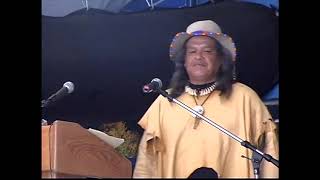
Olson I'm with the Lewis and Clark National Historic Trail and core of Discovery 2 200 years to the future I want to welcome you here today I had a really good opening line but it's rained so much I'm going to pass on that opening line my job this morning is just to say hello and to welcome you and we really are glad that you're here we have uh a wonderful lineup of speakers that will be here in Fort Benton through the 12th of the this month before we go up to Rocky Boy for 4-day weekend and then back to Great Falls and we'll be there June 25th through July 24th we hope you come back to see us at all of those venues we have literally dozens of unique programs at each one of these venues so I just wanted to U make sure you know about that and uh what I want to do right now is to uh open with a blessing and uh Clint Brown uh who is a Montana will come forward to do that and if uh ladies you'd make sure your husbands have their hats off we have stand well hey my name is brown I'm member of the robot reservation here in Montana and I'm very blessed and I'm very honored to be here today to uh speak in front of you first of all I want to apologize to the elders my elders that I'm here standing in front of of them and talking at the same time I was asked to come into a prayer and when uh we as as Native American people are are are given that great honor to step forward so I want to say a prayer in my own language I want to prayer for all the people that we have here all the people behind the scenes I want to thank the Creator for the weather that we have today that the good moisture that we're getting in Mother Earth want to thank all the people that came here today uh we would like to ask the Creator to have special blessings on people who travel long ways there people that are away from their homes and their families ask that when they get home that those things may be better than the way they left them I'm going to go ahead and say a prayer in my own prayer Pray along with me uh I was always told as a young man that there's one Creator no matter which way you choose to talk to him or or believe in him it all goes to the same place and strength and courage did Nots off all the people get up and speak here that the message will they'll get their message across to the people say I want to thank everybody for coming today I want to especially thank from the Native American point of view I want to thank the uh National Park Service and the people that are are doing this uh doing the the War I the traveling along the trail I truly believe it's a great chance for our people not only the Native American people but the people from Fort B the people from Great Falls the people whomever where wherever they stop it's a great chance for us to tell our story from a local point of view as opposed to something that they might read uh that little piece in the history book or that little piece in the newspaper once again I want to thank all the people behind the scenes because it wasn't for them wouldn't be standing here today hope thank you well Clint said it best this is the tent of many voices but it is one voice and that's the voices that have come together to tell the stories in every aspect we are very very honored to have the National Park Service here the BLM and and the other federal agencies that have partnered with shto County and Cascade County and particularly you're sitting here along the banks of the Missouri River that made this all possible between both counties and to make the signature event this 10th National signature event possible we have been working for three years Peggy Bourne is our executive director and she'll be talking later we have put an me tremendous amount of effort into making this one of the most pledgeable most memorable and to as I would say put your own signature on this event we're going to start out today with the shotto County Commissioners and that's where you are today you're in shotto County Fort Betton Montana and you're on the shotto county fairgrounds and so we're going to start with our story the chairman of the shto County Commissioners is Jim O'Hara Jim O'Hara is not with us today he is away on another Duty um but he has been sitting for three years on what is called Explorer Council and that was made out of uh County leaders and city leaders um agency leaders from both from both counties from shotto County and Cascade County and every month for 3 years um there would be a 2 to three hour meeting and Jim was usually there and it was from from efforts such as Jim O'Hara speaking for shotto County and myself Valerie morgar speaking for shotto County also that we came up with what are now the activities and the events that you will be attending in the next days um we were very very pleased with representation that Jim oara brought to um and to to the Explorers Council and for you shotto County he has been very eloquent he has been very proud he is a farmer from um out going towards geraline out east and so he wears that that proudly and he does a wonderful job I'm sorry that he's not here today um he has been called over because of the wonderful weather that we've been blessed with as a farmer we are we really believe that this is a wonderful thing and so don't feel bad you guys from Oregon or national park Serv or core two people you guys we welcome you and we welcome the rain um he's been called over actually to Highwood Montana which would have been the scene also of shields Creek but I think Shields Creek is overflowing now and um he's been called over there to monitor that that area and to um and and and to see if they're going to have to do something special with Highwood so that's where he is today but if you have a chance to see Jim O'Hara please tell him thank you for his three years of attending those meetings and and uh talking about shotto County and um bringing the best to those meetings I'm going to turn the podium over now to another commissioner we have three and the next commissioner is Harvey warl and he is from LMA Harvey greetings and welcome welcome to shodo County myself and the other Commissioners extend a warm and rainy welcome to you Jim O'Hara our chairman of the Board of Commissioners was was to open today and and to explain our involvement with the explore the Big Sky but as you know he was called away as you know we we wear many hats as Commissioners president personally commissioner O'Hara is dealing with flooding emergencies in his district along with there's five or more bridges out and roads are a lot of water running over the roads and they're starting to evacuate some areas Sher county is the 10th largest county in Montana it comprised of 3927 square miles and has a population of 5576 of the nicest people people you ever want to meet maybe there are 56 counties in Montana and this County alone is larger than three of the smallest states in the nation one of those States is Rhode Island which has more population than all of Montana and it's a third to size of Mont shotto County one of the problems the Commissioners face is maintaining 2400 mil of gravel roads uh although the rural population may have a difficult time traveling on muddy roads no one would dare call us to complain on the conditions this moisture is really needed here we've been going through so many years of drought well we didn't expect it so um farming is our main stay in shodo county and all three of us uh would like to in would uh all three of our commissioners are farmers so so therefore I'd like to introduce my fellow commissioner Ken Evans and he will talk about uh farming in shotto County thank you thank you thank you Harvey and again welcome to shotto County uh agriculture is our main stay and one of the request that was made of the Lewis and Clark when they made the travel to the West Coast was to look for future agricultural lands and unbeknown to them as they came through this and looked this area over this has become the Golden Triangle of Montana which raises a high protein high quality winter wheat it's sought after by many foreign countries the we are ranked number one in the state for uh grain production and and 33rd for cattle production we have a total cash sales of $58 million of which 44 million of it is wheat or grains and 14 million is uh livestock there's 790 Farms so it's pretty big sparse area with uh large farms and this rain you're seeing is a miracle you know a week ago a lot of us were looking at crops and pastures that were disappearing and drying up and we could see our income flying away and thinking boy boy here goes another bad year we've been through a lot of them already and when that happens the local towns people the local businesses suffer the schools suffer because of can't pay taxes and just nobody has any money to spend so we have a miracle here we had a bumper crop started this spring and now we have a prospects of a really good crop maybe again with this kind of rain if we can get some more rain as this goes along so somebody said well this is a million dooll rain I don't agree when I looked and seen what $58 million worth of egg products out of shotto County I'd say this is maybe a $30 million Reign so with that I'd like to thank you for coming have a good time enjoy yourselves and come back again we'd sure like to see you thank you my name is Rick England I'm chairman of the scho county fair board where you're sitting right now is fair property owned by the county of shotto County I've been asked by Lori Hardy to do this she seems to get me into a few things and she's a good friend of mine upon looking she upon looking for the first Fair ever in shotto county that date is a little bit vague as the first fair was held in shinuk Montana as our County High School was in H this apparently was to P pacify early attempts at a County division as at that time shotto County was huge shotto County in 1876 reached from the crest of the Rockies to near Malta down along the Missouri River and over to arrol criek in 1893 Teton County was formed off the West End in 1911 an election determined to an election determined the creation of Hill and blame County effective in 1912 and so that brings us to the Sho County Fair the sh first shto County Fair ever to be held in Fort Benton was reported in the River Press September 18th 1912 it was held in the Armory downtown as there were no fairg grounds per se it says the general desire and this is from the River Press the general desire to participate in the shotto county fair is one of the most gratifying features of the undertaking the funds necessary for holding the fair was subscribed by the Fort Benton citizens in the belief that the residents of the other parts of the county would respond with exhibits that would make it all a success and this would belief was amply justified by dis Pleasant displays in the various departments summarizing the first Fair the River Press stated band concerts by the second regimental band during the time of the fair was in progress furnished excellent music entertainment for the crowd in attendance the program of sports races and additional attractions the first Sho County Fair is such a successful project that its annual reoccurrence on a larger scale is assured and we've never missed one since that date the fair property was then purchased for the price of $1,500 December 14th 1912 on April 16 16 Henry Hagen was hired to build a fence around the perimeter and there's some old pictures up at the egg Museum that shows just a basic building out in the middle and a white painted white fence all kind of like out in the middle of a prairie out here it was reported Again by the River Press September 17th 1913 that the second annual fair was a huge success including horse racing motorcycle racing and many festivities and I would like to note that at that time the Commissioners appointed the uh Sho county fair board which consists of a five member board throughout the community ranging from Highwood Carter Big Sandy Fort Banton Geraldine areas and that me five member board in turn hires a staff and our budget is supported by the by the county with the funds that we we bring in and this is how the fair has been since 1912 and at that time the Commissioners appointed a uh superintendent to handle each one of the events sheep cattle horses and whatnot my great uncle Jurgen England was the chairman of the sheep division so I've I've had kind of enjoyed this project our mission statement as a fair is the purpose of the shotto county fair is to provide educational entertainment and recreational opportunities for the general public and preserve the heritage of Montana agriculture this is accomplished while promoting and showcasing the talents interest and accomplishments of the residents of Montana especially shotto County residents Lori also asked me to touch a little bit on some of the past things events we've had over the years and I guess first comes out was horse racing was very popular in the area the JC demo derby then took off uh shotto County Tractor pullers Association held huge tractor PS which was some of the most popular in the Northwest we still have rodeos om moxies Team Roping many horse events musical entertainment 4H and youth of all all kinds come to the fairgrounds and and use our facilities in the 93 years since the first fair was held in Fort Benton there's been an ongoing commitment to improve the fair grounds and this continues today in the past few years the fairg ground has seen many improvements including the resta ation of the grand stands and other historic buildings the building of the canoe launch campgrounds new Fair office restroom and shower facility and a brand new 70 by10 building right behind you for year round use is with the co cooperation of the County Commissioners past and presid fairboard members managers secretaries the residents of shotto County and the huge support of the lipt clay waterer Foundation it is with that that we have this facility we are proud of and we hope you enjoy while visiting our great County we welcome you to our Fairgrounds and we hope you enjoy your time with us thank you I now I'd like to introduce Steve Adams superintendent of the Lewis and clerk National Historic Trail of core Discovery 2 thank you Mr England and welcome to the tent of many voices I want to thank uh Clint Brown uh for his Blessing to begin this this program you know it's folks like Clint that really bring this place to life and they come up here and they share their culture with us U and we just really appreciate that Clint thank you very much uh thanks Val for the the work that you've put in on this and and the other 353 days is it a year long almost a yearlong celebration it seems like it uh I'd like to thank the County Commissioners for what they've done uh Mr England for allowing us to be here at his facility and uh we uh is this are we still at 100% in our venues for rain okay all right we've been to I don't know how many venues but it has either rained or snowed at each and every one of them so uh somebody suggested we may want to call this the tent of many rains uh I'd like to thank also our colleagues who are with us today and and with us often on the trail from Bureau of Land Management the Bureau of Reclamation Army National Guard has just been an outstanding supporter of uh what we've been doing across the country and it just wouldn't be possible without them uh thanks to Peggy for all the work that she's done and will continue to do over the next few days it's it's a tough job and uh you know give give Peggy all the support that you can uh I also want to thank uh Clint talked about some of the folks behind the scene and the folks that you see in the the Blue Jackets and the blue shirts that's the Legacy staff and they've been moving this exhibit across the country for the past couple of years and they've done a superb job and getting us there getting us there on time getting this thing set up and prepared to go and especially want to thank our core two staff the folks in the gray and the green uh they have been been doing this job day after day for the past several years and you can appreciate I think uh being away from home uh a year at a time almost and being continually uh you're either working or you're driving and uh they've just been a marvelous staff and again it wouldn't be possible without these folks doing all of their good work so thank you thank you very much for what you do and with that I'd like to U introduce the Explorer the Big Sky coordinator piggy Bourne good afternoon the first time I had the distinct pleasure of being in this tent was when it was in Montello and it felt about this cold too maybe a little more maybe a little colder in monachello the neat thing about this tent is as I've had the opportunity over the last 2 years to travel to loen Clark Trail attending other Signature Events um this tent is and Core 2 seems to be the common boundary the common element with all of the Signature Events and you begin to make a lot of good friends and you see a lot of great people all along the trail I remember walking um into the signature event in Louisville and who did I see performing but Clint and it just brought Montana right home into that tent with with me and it was just a wonderful feeling that all of us along the trail really are one big family and we've all been working very hard over the last many years personally for me it's three and a half years but I know a lot of people in the audience have been working a lot longer than that on the bicentennial commemoration and um we've all become one big happy family and it's been a wonderful experience um I'd like to welcome you to one of the activities one of the um or the third day of the loen Clark Bicentennial signature event called explore the Big Sky we've been working on this event for three and a half years and like I said earlier we've made a lot of good friends um the communities of Fort Benton Great Falls LMA Geraldine all those communities have bonded together to offer the world a unique and wonderful opportunity while they visit Montana and to listen and hear and learn about the Lewis and Clark Story um that occurred here 200 years ago our goal when we began planning the signature event was to provide a cross-cultural approach to the examining the Expedition through as many different means as we possibly can we also wanted to examine the story in as many different mediums as we possibly can anything from reenactments and after today you'll be able to go out to decision point and see a firstperson reenactment of the campsite that they had 200 years ago through Music Arts dance lectures tours float trips community events and events that are showcasing our Montana Indian culture in over the 34 days there are over 180 different activities that will be offered many of them are offered several times and I'm proud to say that the core to um programming in this tent is one of those 80 different activities and the people who have put the programming together working with the Core 2 staff have are put together a fabulous slate every hour there will be a different performance in this tent and then you can't forget the the tent that has the um exhibit in it either because it's also extraordinary and certainly worth the time to uh spend in it and to learn and to and to see what it has to offer I invite you and encourage you to go to as many different activities as you possibly can um each one of them has been sublimely planned welcome to explore the Big Sky welcome to Core 2 Welcome to shto County and it's also my pleasure to welcome our next speaker who's June Bailey who's the field manager from B um BLM from Lewis town thank you thank you Peggy and good afternoon I would like to extend a very special thank you to the city of Fort Benton the National Park Service and all of you who have planned and worked so hard to make this portion of the ls and Clark VI Centennial such a memorable time for everyone I'd like to speak for just a few moments about one of our truly unique areas the little Missouri River it's been described as a Crown Jewel of the entire Lewis and Clark Trail and I'd also like to talk about our role here in Fort Benton blm's role in our working relationship with Fort Benton and our other Gateway communities such as Big Sandy winterred and Geraldine has been crafted by the history of our land water and people some of this history has sped by in centuries some in decades but it all leads us to where we are today and indicates where we may be tomorrow long before 1805 Native Americans used the upper Missouri River and its surrounding lands as a pathway through their lives the river and these lands provided many of the main components necessary for their daily survival in 1805 Lewis and Clark and the core of Discovery ventured through this portion of North Central Montana and their toll and Adventure became part of the American Legend unique portions of this area have remained largely unchanged in the nearly 200 years since they've traveled through here on their epic journey in 1976 149 miles of the upper Missouri River were added to the National wild and scen Scenic Rivers act to facilitate that special multiple use legislation the BLM was named as the managing agency the citizens of Benton and area land owners all along the upper Missouri National wild and Scenic River help Forge a management plan that address management issues and most of the social concerns surrounding this new designation Fort bton would naturally serve as a beginning point for many of those coming to North Central Montana to enjoy this 149 M long wild and Scenic River these circumstan es formed the perfect opportunity for even stronger Partnerships between Fort Benton and BLM the BLM managed the public lands in this region to provide Li livestock grazing Recreation minerals and Timber for several decades the use of these public lands remained mostly dispersed and somewhat in the background of North Central Montana then more people began boting and floating the the Missouri River Hunters began using these lands and Waters more and more the expectation of livestock mineral Timber and other Recreation interests began to focus on public lands to respond to these increasing expectations the BLM had to focus our management of these lands and to become more of a presence Partnerships and working relationships among interest groups communities and the BLM M were in their formative stages in the late 1970s BLM increased our presence in Fort Benton we had a seasonal staff that worked out of the back of a pickup and it was located down by the boat launch later we moved into an older trailer which served as our contact station and office facility for this seasonal staff a few years later as the demand for services and information increased so our presence as we increased the seasonal and volunteer staff and moved into the visitor contact station now located on Front Street throughout this Evolution the relationship between Fort Benton and BLM became stronger and stronger we at BLM feel the river designation has been a positive development for the community and the BLM in 1999 discussions about a special design designation for the public lands adjacent to the upper Missouri National wild and Scenic River began to evolve and in 2001 a presidential Proclamation designated the upper Missouri River breakes National Monument Lewis and Clark first encountered the breakes country of the monument on their Westward leg in his journal Clark described the Magnificent White Cliffs the Abundant Wild life of the area and on April 29th 1805 the Lewis and Clark expedition recorded the first big horn sheep observation by non-indians in North America this is one of the few Landscapes along the entire Lewis and Clark National Historic Trail that remains remote and nearly as undeveloped as it was in 1805 the people of Fort Benton and area landowners are helped the BLM once again prepare a management plan for this newly created Monument that will address today's resource issues and social concerns we'll soon be breaking ground in Fort Benton for construction of the new interpretive center for the upper Missouri River breakes National Monument this project is truly a partnership among the city of Fort Benton the river and plain society and the BLM our partnership with Fort Benton and in all of our Gateway communities has come far from what seems like just yesterday as we look back and Marvel at the accomplishments of Lewis and Clark and how all of our ancestors evolve to meet the challenges of their day it's a little easier to see how the BLM has evolved around the use and enjoyment of our public resources we look forward to continuing our service to the public while strengthening our Partnerships with with all who use or care about the public lands thank you and I hope you en enjoy this great event some of you have heard me talk about Lewis and Clark in the past and I've been giving Lewis and Clark talk since 1983 but this ain't one them I'm here to welcome you to a good old Fort Benton on occasion I portray different historic figures and uh today I'm sort of portraying Andrew Dawson the Scotsman who was the factor here at Old Fort Benton the trading post from 1854 to 1864 when he retired and went back to his native Scotland so as I walked in the Ten of many voices today one of my compatriots said Bob you can't come in with those Wellington Boots on it just doesn't look right and I said well Andrew was from from Scotland these Wellington Boots Were Made in Britain Scotland and England joined in 1707 to make Great Britain so these Wellies are appropriate now we've heard about curses today and we've heard about blessings and uh the last five or six years has been a curse to the farmers in shotto County this rain has been a blessing the last five or six years of drought has been a blessing to those that recreate on the river Outdoors and to some of the event planners the last couple of days have been a little bit of a curse because they've had to make some significant changes all in all we welcome the rain but Fort Benton and I'm going to be telling you the next 10 or 15 minutes since I'm supposedly the keynote speaker and Valerie said I can talk for an hour but I'm only going to talk for 15 minutes I'm just going to give you a few vignettes about our Fort Benton history Fort Benton is used to curses block 25 in Fort Benton which is the block directly across the front of the shotto County Courthouse was also known as the hudo block the first structures built on that block were a Gallows a wooden Gallows in the 1860s and a small wooden jail and there was also a well that was dug on that block which picked up the uh niker of The Well of gotha for good reason they used to stuff human bodies down there both white and Indian anyway Billy Hensel was hung at those Gallows in the early 1870s and there was a squa man who was uh whose father-in-law came to town got into an altercation he was killed he was put down there but there were also white men that were put down this well then when the military came here after 1869 they were here until 1881 there were three uh soldiers and uh after spending 20 years in the military and another life I know how sometimes you can party hardy and they got put in the uh jail overnight somehow the jail burned down and all three were burned to death then a fell came along and he built a house on this block on the hoodoo block and he built a livery stable several weeks after he built his house his wife died about a month later he died and then his house burned down then another fell came along and on the opposite end of this block built a furniture store he no sooner had that built than a high wind came up in Fort Benton and it completely destroyed that furniture store but didn't touch any other Block in the uh small town of Fort Benton in the 1870s and then shortly after that the Livery stable burned down there are now I believe nine structures on that block and the curse lifted right around the turn of the century so Fort bton has had its uh share of curses Fort bton is the oldest continuously occupied community in Montana having been laid out as a trading post by Alexander Culbertson in the fall of 1846 and then it was constructed in the spring of 1847 from the logs from Old Fort Lewis which was a Trading Post just up River on the south side of the Missouri and it has been continuously occupied since that date it was originally called Fort clay and then Fort Lewis named for Fort for Maryweather Lewis but then on Christmas Day 1850 Alexander Culbertson the founder of that Trading Post and the factor of bgea commissioned it Fort Benton in honor of Thomas Hart Benton who was the retiring senator from the state of Missouri he had been the state of the uh the senator from the state of Missouri from 1820 to 1850 he had helped out the fur trade company when they were having some problems in terms of trading whiskey in Indian Country so Benton was a supporter of the Shoto family and the American Fur Company and thus the fort was Christen Fort Benton oddly enough he had a grandson by the same name Thomas Hart Benton who was a painter some of you may have seen some of his work he lived on into the uh 1970s and then when he was about 80 years old old Jack lepley took him down river in the late 60s at the mouth of the Marias there was quite a bit of uh press there there were some people photographers and so on and Benton proceeded to strip naked and jump in the water he said he always wanted to jump in the river at the mouth of the Marias and lefley said I don't think that's a good thing to do here he said G darn it I'm 80 years old I can do anything I want so the spirit of Thomas Hart Benton still lives after Mar weather Lewis left this country in 1806 it was a full 25 years before the first Trading Post was established at the mouth of Marias Fort pagon we don't have time to get into that story the black feet this was black feet country and they did not want the uh Americans coming in and trapping their animals they didn't mind trading they'd been trading with the Hudson Bay Company for a centur before but they finally agreed that as long as you traded and didn't trap you could establish a trading post and there were a whole series of trading posts established Up and Down the River here between the mouth of the Marias and just above where Fort Benton is but Fort Benton was the last one it was a trading post from 1847 to 1869 and then the military contingent came in when they closed down Camp cook at the mouth of the Judith and from 1869 to 1881 there was a military contingent here the first houses outside of the trading post or Fort were built somewhere between 1858 and 1862 we think 1862 is probably a more correct time period so in the 40s 50s and 6s you had a tremendous trade with Buffalo robes and hides uh with the Blackfoot with the white clay people also called the atna and the uh the groon and we had uh one we had Clint give the blessing uh the uh White Clay people were closely affiliated with the Blackfoot Confederate Confederation up until about 1863 when they had a falling out so you had those kind of tribes trading here but then uh when the first Steamboat came in 1860 uh there were 148 different steamboats that arrived at this Levy between 1860 and 1887 when the railroads came through and put the end to steamboating and Ken Robinson is going to give a talk uh later on not today but one of these days forthcoming about the whole background of steamboating and its Legacy with regard to Fort Benton's history Fort Benton's history is so rich that all I'm going to do is give you a couple of uh uh quick doters decade by decade and no no possible time to fill in the uh uh all the detail which is uh incredibly interesting and Rich uh by the 1850s you had a number of trails that led out of Fort Benton because because of the river before the steamboats came you had the Mao you had the proges you had the keelboats and uh the trails that developed in the 50s and 60s included the Fisk Wagon Road out of uh St Paul in Minneapolis you had the Cow Island Trail you had the Graham wagon route that went on the south side of the river you had the trail that went down to Coulson which became Billings you had the whoop up Trail between about 1869 and 1874 that was the trail heading up into Canada and you had the Mullen Trail which led over to the goldfields and on over to Walla Wala Washington established between 1858 and 1862 gold was discovered in Montana in a big way in 1862 and uh that's when the settlers started coming in and the miners and the people who supported the miners and the uh the trade here started declining a bit uh because of that incursion of of but uh there was a fellow named John Silverthorne who showed up in Fort Benton in 1858 and he came in and Alexander Culbertson was down here at the time visiting he was really at Fort Union at that time Andrew Dawson was the factor but he came in and he said I've got about a $1,000 worth of gold dust here so Culbertson looked at it he wasn't sure but he decided to make the gamble took in the Gold Dust for trade goods and so on and Silver Thorn left they never saw Silver Thorn before and they never saw him afterward and then when that gold dust was assayed it was worth about 1,600 bucks so Culbertson made out well on his gamble but uh we don't know where he got that gold so there might be some gold out there in them there hills that hasn't been discovered yet so that's sort of an interesting vignette in the 60s and into the early 70s is when all of the structures in Fort Benton were basically made of wood it's when the bloodiest Block in the west and you can read the levy signs when you go down the levy it describes all of this uh was in existence and you had the bordellos and the Opium dens and the taverns going 24/7 and then in the toward the late 1870s they started to bring in the churches and schools and everything went hell uh the last big prosperous era for Fort Benton in this historic age was between say 1878 in 1884 that's the period when the steamboats were uh coming up here in a big way as they had been nobody projected that railroads were going to put the end to the steamboat trade it's just like the railroads in the 20th century forgot they were part of the transportation Network they thought they were just railroads and they'd never decline well that's how they thought about the steamboat traffic between 1878 and 1884 there were three brickyards working full-time in the Fort Benton area and all of the brick buildings that you see in Fort Benton the historic buildings were built during that time period the old jail which is been torn down 1881 the Shoto County Courthouse which is the second oldest one in Montana in the early 1880s uh the Grand Union opened on November 2nd 1882 if you walk down Front Street and you look over the uh drugstore uh Benton Pharmacy you'll see 1882 up there in the brick work when you walk down Front Street a lot of times and this is true of any Community you want to look above the street level look at the Second Story level same way in Great Falls and you can see some of the historic structures that haven't been covered over like one guy told me one time it's like an aluminum salesman came to town in the 1950s and changed all the storefronts but uh at any rate very rich history through that era then quickly uh after the decline of steamboating and so on you had the Open Range era in the 80s and into the 90s very short period of time but that's when Charlie Russell used to come here on visits and uh you had Sullivan the Saddler and you just had a lot of the uh uh stock associations and so on this was a good open range country and then the homesteaders came in uh roughly about 1908 1909 into the teens that was the big homesteading era and uh when you go to the Museum of the Northern Plains it will describe this uh whole U era in detail and it was also like this there was a lot of moisture between about 1908 and about 1916 or 17 in the World War I when the grains started coming in in the big Focus because most of your early homesteaders 75% of them came from the Midwest and they knew how to plant corn and beans and so on and that's what they planted and they had rain and it worked so you had a great influx of homesteaders then you had the war things started turning over to wheat and Grains and then you had a drought from about 1919 into the mid-20s and that's when you had a great Exodus of people and you started consolidating these units as has occurred right on to the present time then we had the dirty 30s and uh you go on in the World War II this County and area was very patriotic uh seven flag officers were born right here in Fort Benton and uh you can read about them in in our museums then after the war you had the continual uh grain production which uh Ken has alluded to and uh this is the richest grain producing County of the entire 56 counties in the state of Montana so the agricultural Heritage is Rich and uh then when they came in with CRP the conservation Reserve program uh that put these small communities Under Pressure because there wasn't the input costs and the products that you needed to purchase but we're surviving our future is agriculture it's Heritage tourism we have two wonderful museums we have a homestead Village and we've got a partially reconstructed Old Fort Benton the oldest building in the state of Montana is the Block House at uh the Old Fort so uh we've got a lot of interest information provided through our Levy signs and uh there's a lot of good tours that are provided in this community so uh welcome to Fort Benton and uh as Andrew Dawson it's my uh privilege to uh welcome you here and since I died in 1871 I can now reascended okay now I'm sad I'm up here because as a realtor I have to reveal that hoodoo um curse but then you said it was lifted so that's okay and my dad Wally morgar happens to live on that block so I don't know I also wanted to um tell everyone today to please before you leave we have some refreshments over here and there's when Sandra p and I had and and Lori Hardy had said what are we going to serve and and kind of have you know it always says eat dessert first so um what are we going to have in the tent oh well it'll be so nice we'll have lemonade iced tea well yesterday we switched over to Hot Chocolate um coffee and hot tea but I also want to bring your attention to some wonderful cookies made by a SHO County Farm lady Beverly grass and um she comes from Wheat Farm up at box elder and she has graciously made us cookies in the shape of Montana that show the river and where we are today with a little red dot for Benton Montana let's give her a round of applause before I turn the mic over to the to the stage director Amy I'd like to have a just a little wrap up I have been very privileged to serve with the Explorer of the Big Sky um all the patrons and and all the people that we've partnered with um Bob archal said something the other day and it really was true about our whole journey that we put together and that is that we started out with a destination but what became important was the journey and I think for us we really realized what the journey was and that was what we really have here and and Bob Durk said it so eloquently is our history and Kenny Evans alluded to it with our Agriculture and then you coming here whether you're commissioned or you have a Cham of command to be here or your ancestors have come here we all have arrived at the same place but it is about the journey and we have learned so many things throughout this journey we've we've learned to say yes we've learned to be flexible we've learned to wear different clothes we've learned to wear different hats and it was it's in that in that manner in that spirit that we have all come together to tell our story beginning here in Fort Bon Montana and it and it is no mistake that Fort bton is known as the birthplace of Montana and I think it's so appropo then that the 10th National signature event for explore the Big Sky Starts Here at Fort Benton Montana in shotto County I want you to as you sit in the tent of many voices for the next approximately 10 days until um June 12th I want you to put on the the stole the ER stole that was given to Lewis and um Bob archal the noted historian and an author spoke so eloquently on that in LMA and he put on that stole and he was metamorphosed and that means he was changed the speakers that we have coming to you in the tent of many voices that has been put together very very competently by Sandra Padia and thank you so much Sandra for participating in that she has made sure that Community was represented she has made sure that the agencies are represented and she's made sure that the tribal people people are represented everything comes together as you sit in the tend of many voices and and go through the exhibits put that on and let yourself just be wrapped in what is being told the story that is told and maybe just maybe will be changed also and this will be our journey thank you so much and I'm going to turn it over now to Amy the stage director on behalf of the National Park Service I would like to thank all of our speakers today for coming out and I also would like to thank all of you for joining us next event that's going to happen here inside the tent of many voices will begin in about 15 minutes or so and that is going to be a film entitled Lewis and Clark Confluence of time and courage so I encourage you to come back for that film in about 15 minutes I do have some schedules of programming inside the tent of many voices for the next week so so if you'd like a copy of that schedule please stop up and see me afterwards in the meantime we do have our child siiz keelboat a Great Plains tee our exhibit tent for you to explore today enjoy the rest of your day everyone