Tent of Many Voices: 06130601
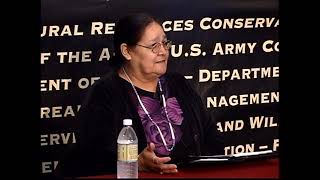
and ladies and gentlemen at this time I'd like to introduce our presenter and since she won't have very much time I'm going to make my introduction short and sweet and uh we have with us Bernice Moffett who is an elder and this is entitled a visit with an elder so at this time let's please make her welcome first let me apologize for being late we were uh were coming down and it seemed like everybody was uh following the speed limit for a change and then uh so we were following these big trucks that we're slow the um the thing that I would like to share with you this morning is on this afternoon is the U a story of the Elder Circle we uh the Elder Circle was organized by Alan slick Boo and uh Ricky Ellenwood the uh our people were fast losing our language there were a few fluent speakers left left and then some of our people that uh were real fluent speakers were passing away and we needed to preserve our language so we uh they organized we were away from the reservation but when we came home and my husband and was selected to become a part of the group well when uh he had a slight stroke so he decided that he better not try to do this anymore so I when I went in to resign for him then they elected me to fill his position so I've been on on the committee for the past 10 years and the uh our order of work has expanded we were interested in uh trying to uh bring our language so that the children could read and that they could write it the uh Dr Haru ioki with a number of our elders uh did a dictionary they worked on it and for several years and it's about that thick so if you want to carry a dictionary around that think to uh we uh have that in our uh reservation but being a linguist he wrote the language in the way that he hearded it and used the um the signs that he could understand because some of our sound is from down here some was from up here some are are more nasal so the children were having difficulty besides our elders were having difficulty with the two so the Elder Circle then worked out a simplified way but using some of those so we uh we had this uh uh starting our own way of spelling we've been fortunate that uh LC saw that this was going to be something that needed to be expanded to our college students so they offer it as a minor here at the school we also have it taught in the laway school as an elective for their students and then we also have after school programs in the laway school and at the uh orino and CI school systems this is where we have the more of our young people going to school so uh we started out that way we thought this was a good thing to do and we have um expanded and we kept expanding uh the language program well the other thing we are also involved politically the other thing that we were having difficulty with was some of the area places that were using the word squa and papoo to identify uh these areas either a creek or a part of the community so we we said this has to change so we worked with the national park and National for forestry and we were able to change some of the naming you can go down to uh rigin and where it was called squa Creek it is now called Yellow Jacket because that was what our people identifi that place as being a yellow jacket area so we were able to do that and going up uh the road down 20 on 12 there's some places that have been changed and uh because people were having difficulty in in using the way that we said it they use the translation and so we've worked with the state of Idaho in those uh in the naming part of it so because they have to change the maps and so it's been a process it's been a long process but we're getting there and I always say is it going to be during my lifetime I'm 75 years old and so I to I always question things is are going to happen during my lifetime but as probably some of you feel that too things change slowly or either they go too fast and the other uh area that we have besides that is that we try to teach our traditional way to our people we start start having young uh married families come in and ask us about the naming ceremony because they would like to name their children and use uh an ancestor's name and uh what we did with one we made a name up for them because of what their given name was and so we were able to use that because the name that they had selected had already been used and there is a protocol there is a protocol and uh people using you don't go out after you're uh anybody's name you have to ask your elders is this our name and then so this is the uh we printed a pamphlet and so we give it out at the powow because this is where they usually uh do their naming although in the past it sometimes happen happened on birthdays some of our people even had the naming done at baptism so there are different ways that people Ed to name their children and as they got older sometimes because of their lifestyle they would change their name again because of something that they have done or somebody recognized some some uh uh thing about their character that they would be given a different name so we so we got into the naming part of it then the other thing was that uh we have memorials at for those people who have passed during the year and so then there's even a protocol and what you do with that and so we were able to help some families that were questioning just like everybody else our young people have moved away and they've come back and they've had difficulty in uh in finding out well what did our people do so that's our role that's what we're supposed to remind them about and so we from just language we have expanded to other areas and we we feel that this would that this is important because it tells our people who we are some of our children children are um mixed tribes they have several tribes that in their background and so they have uh to understand about their father's side or their mother's side whichever and sometimes the father and mother have two tribes that they're involved in and so the children then have a uh they have to find out well who they are and so then one way that they do that is by enrollment or uh you have to be 1/4 nesper to be enrolled in our tribe and so sometimes our children are 1/4 npers 1 14 yella 1/4 Navajo 1/4 Sue and so then the parents have to pick out which tribe their child is going to be enrolled in or where they're enrolled or where they feel that CL closeness so that's what the Elder Circle triy to help our young people do and I guess that's our role I guess it's the role of all Elders no matter uh where and who you belong to so we've tried to help and understand the other thing that our language teaches is discipline or there are words in our language that uh discipline children children and disciplined adults that we don't find in the English language what I call English is more like Amer American slang more than it is English because way back when if someone was gay you felt they're happy but now if you say someone's gay you're giving them a whole different definition and when uh people used uh my girlfriends and I used to walk walk around holding hands now if you see girls holding hands you're saying oh they and so the some of the things that change have also come to us too in that changed area so um we understand how this happens that we don't uh I don't use the computer and i' uh I don't like the way that it that you have to depend on that to find out you can even pay your bills with the computer and I don't do that I still write it out still put a stamp on it still mail it out because that's that's as close to being modern as I want to get so all right there uh if you have any questions that I'd be glad to answer I'm try tried to touch on several areas yes ma'am coming right over hello how do you get to be an elder pardon how do you get to be an elder well the the law says 65 but uh in our uh Indian family because of the uh the age we have uh started out at 55 and some of the people say I'm too young to be a Elder at 55 so it's mainly a choice but they can still qualify as an elder at 55 but uh everybody else is retirement at 65 so some here's another question right here thank you for coming Bernice I know the road's been a mess the last last few weeks so we appreciate your time I would like to know or have you share with us who your people are and what your other name is in npers she'd like to know a bit about your heritage who your family is and possibly if you choose to tell us your name in Nez purse my uh Indian name is un po I was born in September and now that's un my call and so I think that's why my parents gave me that name the um the other my background uh I descended from Chief Joseph and my family my maternal side of the family is from the walaas and so that's where U my line comes my husband's uh belonged to the uh lawyer family his descended from uh Twisted hair and so he always used to say I married a non-treaty person so that uh we have um uh his line uh we have he's a third generation Presbyterian Minister and my son is a minister over at Clark at the United Methodist Church yes uh Bice it's really nice to have you here today and um I this is really good information for me as a tribal member because um if it's okay if people ask me like where they can find out about name tribal members you know and so much of our old system is broken down so I can refer them to see I I wasn't sure about what all the circle of Elders did so I I'll be referring people up to your to your meetings in I think that's really good is that okay yeah so would you elaborate a little about the circle of Elders do you meet on a regular basis pardon I the circle of Elders yes do you meet on a regular basis yes we do we meet the uh uh second Thursday of every month and we rotate from laway camei and orino we try to hit all of the areas so that we uh we and people are welcome to come and visit us and if you have questions this is a good place to ask because we have people in there that are uh that were r raised in a traditional family that they were they followed the traditional way they followed the native religion some of us have uh gone and uh followed the Christian church but then my people were both we did both because our um our native religion teaches the same thing that Christianity you need to treat your family right you need to treat your tribal members right you need to treat everybody that comes in the door with respect and so that uh so it was easy to make that transition and uh although with some of the denominations you needed to cut your hair give away your regalia there was some strictness to their following but uh our family were one Methodist Church on our reservation and there are six Presbyterian churches on our reservation all right I don't think we have much time for questions but if you'll be around I'm sure you wouldn't mind if someone asked you questions and Ladies and Gentlemen let's please thank Bernice Moffett for coming in and joining us today our next our next program