Tent of Many Voices: 07270403T
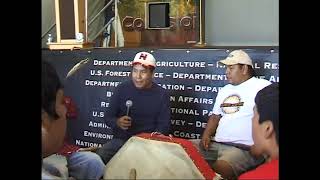
is a mobile exhibit exhibit with the National Park Service and we are moving across the country over the next 2 to 2 and 1 half years stopping in different communities along the way sharing different parts of the Louis and CLK story today you are inside of the tent of many voices and the tent of many voices has been set up as an opportunity for us to learn from different individuals with different backgrounds different areas of expertise and today we very we're very fortunate to have have with us members of the Omaha nation and they will be giving a demonstration of a social game a hand game that name Americans play if you would please help me welcome Maxine ruus and Brian White thank you uh first of all I would like to tell you a little bit of our our game that we played we have which is called a hand game um to you I guess it would be button button but we keep score on this we also at one time had a game called shimy game and then as we see it today it's the soccer game but we had it way back there with our ancestors used to play the game but this is one that has survived along with the generations is our hand game um we used usually play this game um on different occasions like for birthday parties for graduations for appreciation of anything the family wants a welcome home this is a big event you know now that we our service boys and girls are coming home from the war they come home while we have this game so that they can enjoy themselves and this is our leisure time where we can forget everything that's on outside of the doors and we can just concentrate on the game and have fun with it we usually have sometimes have this um when we have wedding parties this is held and the little kids like it for birthday parties or do we have our masquerade at Halloween have this game and afterwards but in between the games they sing a song and everyone gets up and dance but this is just one of our games that has survived along with the generations I have come down the line we play with we keep scor with sticks like this each side has four sticks and you'll notice that their color different even the tops are the same up here but down here the handle part is a different color and this means that this side has the core sticks and and the for sticks are on this other side here but um we got these Mexican boards we don't have the guy that they used to play with at that time so we set up for these and we use these to play with we get uh two people on each side there'll be two over here that will be able to hide these Stones here to to play button button and then we're going to have someone go and get the feather on this side and one on this side and they're going to try to guess and see which side they have the stone in and we have ways with this feather this is an eagle feather we have ways with this feather that to tell you which side we're guessing now if I couldn't guess on on the right side of my right it means both of your hands on your left so I'll be going this way with this and then for my left side which is your right I'll be going this way that means your two hand his and her are both the ones that are hiding the stones on this side and then if we want to guess your stones are in the middle that both if you have them in the center of your hands then we point the feather down like this that means we're pointing at the middle of your two hands here and then when we think you both have it on the outside like my outside and her outside we'll be holding this feather this way this means that we're selecting the outside to see if you have it and then if you don't have it in the hand you know you show your hand is empty and you show where you have the stone like any other game we sometimes say well some of these cheating over here they're not showing the stone they probably get it but um this is a a little illustration of how we play this we're going to be asking for some Volunteers in the crowd of my little Auntie over here is going to take these Stones around of Christine is uh knowledgeable of of this game here and she's going to be taking these and giving them to certain ones before we start this song This Dance we usually sing an opening song and after we sing this opening song and then we'll begin our game at home we us we have four games to win now this side's going to have to win four games and they become winners but and sometimes it goes back and forth until one side finally wins four games but we're just going to do one game and let you see just exactly how this game is done and after we get started here they're going to be singing songs that we they use while we're playing this hand game you can keep up with the drum however you want to some go this way whichever way you want to go with that stone you can do it the idea is to let them not see and concentrate on your hands to see which P you have it in are you going to sing the opening one version yeah he'll he'll start um my husband Rufus and my son Bri F where our son I should say will be singing this song for us we're going to sing a f song of the opening song of One verse of the opening song but what we us how we usually have these games is um as Native Americans and I'm quite sure you all we always have our creator in mind what whatever we do it's usually with our people we usually sacrifice and we're showing God that we're thankful we appreciate for what he has given us and by me saying we're thankful and we appreciate what is given to is is the family that is sponsoring this puts out food um enough to feed 100 200 people will gather at these kind of occasions at home and the family provides all the food and we say we're sacrificing putting this food before God to let him know how thankful we are of what he has given us but and right now um my husband and my son will sing one verse of our opening song he hey watch when I was saying how to use this okay guess okay you're going to guess this because you're a team over here that's a team over there he's going to guess her ready see the music stopped and we're taking our stones from them because she got them on the very first time h woo we got two good feather guessers here oh you it's going one okay they got one point over here the idea is to get all eight of these sticks on the other side of this G here that we at all over there that oh got you we got to take this guy home here he's good I can't and put them get super okay she got him I thought we were going to win here only had four sticks to go hand want to see what inside your again they one those four sticks back that we barely got they want to back here h you oh all that dancing around all let's go this way or this way got one more stick you got to get them if you don't get them they won the game you are Sav got up to you the carrier what two they the north side beat the South Side you have a little time would you like to try another game all right so the one that had the feather on on the North side keeps the feather because you are the winner now you get to keep it till the next game so the idea of this game is to get all of these sticks on one side all eight of them goes clear over here and each time if they make one then we bring that one stick back over here sometimes it just goes back and forth like this and they finally get them but that's the idea of the game and what we do at this time one game is one we sing what we call a round B song so they'll sing one one verse of a round band song and then we'll say again just usually it's in a big building and a circle is large but with the space that we have we're just going to dance in a circle over in this area here but this is how it's usually de okay now what is done now is that since this side got beat and caused our feather carrier to sit down we're going to go out and we're going to look for another Fe feather carrier that we kind of think might have a good chance at winning this game will'll go with an adult this time and then um before this part is taken of the hiding the stone what usually happens the Two Feather carriers they hide the stone and if one of them is missed that means that your side if they can't get you that means your side starts first and if you can't get her that means her side starts first and and this is how it's done we'll do that this time we didn't do that the first G but this time we'll do it okay now you hi this part here the idea is to guess the first everyone is this first but that's the side that gets to start the game all right okay the South Side gets to start the game yeah this side here these two little ones here look like this cut your hands on the North side you got this the outside hallu okay oh my goodness you're good you want try okay come on let's go right oh Christine right now it's even got three stick on five after get yeah open one St left I be on TV she wants to be on TV she want to be TV okay we got the one last stick so we won the game let outside won the game thank you and this is this was just a demonstration of how we play our hand game for our social activities there's times that we may start early sometimes it takes four or five hours to play this game to win four games on one side and sometimes it only takes an hour and um we skunk the other side when they're stunk everybody's so happy and they're Luling and hollering and whatever noise they want to make they do that at that time but at home we have um some groups get together like we have a a Senior Citizen Center where a lot of our senior citizens go and sometimes the senior citizens are playing against our church the Native American church or they're playing the um Veterans of course but and then sometimes it's even the schools at different times of instead of the children having a recess to what playing this is what they do this is they're having a hand game the older ones there that are teaching our Indian culture and our language in our schools they are teaching our children how to play this hand game and the young boys that go to school there like my son they sit there and they sing these songs with them with them Elders sitting with them so that they can also learn the songs but we just wanted to demonstrate to you to see that we have games along with everything else that we're doing in this world today but I want to thank you for participating and being here with us this afternoon if anyone has any questions we can open up for um questions here for a couple of minutes if you like if you have a question just put your hands up wait for me to get to you with a microphone so everybody can hear I know there are dozens and dozens of different games that the Indians used to play years ago how many do you still practice today the only one that we practice today is this game here that we had we have they used to have the shiny game like I said before but that's has gone along and um I guess I'm not sure because I wasn't there at the time like Paul was but they to use the Buffalo fur and they make it in a ball at so big of a size and that's what they used to pick around and for their rope their string it was the the intestines of the Buffalo dried out into a string and it was rolled around the Buffalo hair so that it could be a strong B yes I am an Omaha Indian from the Omaha tribe I some prefer to be called Native American but I it doesn't make any difference long as they know I'm in Native American how long have you guys been playing these kind of games well for centuries from what I hear it's been here a long time our old people our grandma and grandpas used to play this game and our great grandmas and grandpas played this game when Indians existed about how she asked when Indians existed how long did they exist well I heard someone say the other day that the um average age for a Native American to be considered a senior citizen or an Alber is 55 years old but I passed that Mark so I'm still here and since we still have Native Americans around us they still exist any other questions out of all your games which one do you prefer that you guys like more this one here this handing here of sometimes people are waiting around and another thing that is taking place on our reservation when we lose one of our tribal members um we don't play any games at all uh showing respect to the family that are in sorrow and we don't have any kind of games on the reservation at all in your language what is the name of this game that we just play can you repeat that think we'll take one more question it's the stone how old are you 21 she's more than 55 she said I pass 55 okay I'd like to thank everybody for coming tell your age give a big hand to our thank you thank you very much project that I'm involved with I do work for the National Park Service and I do travel with this exhibit across the country we are stopping in different towns along the ls and Park Trail sharing different parts of the Louis and Clark Story with members with citizens of those towns we have in addition to the tent of many voices and exibit tent a keelboat a small version of the kelbo and a TP that you can enjoy today as well inside of the tent of many voes where you seated right now this is an opportunity for us to learn from and today we are very fortunate to have with us Christine Gerber and she is with Omaha books here in Omaha Nebraska so if you would please help me welcome Herber than so a little bit of background of why I'm an Omaha historian and tell you all a little bit about Omaha history for uh seven years I worked for the Omaha World heral and I had the wonderful pleasure of doing a series of books called Omaha times remember I was to the Project Director for law all of them and Ashley was the one who came up with the idea what they were were they were a series of hardbound books and what I did is I got the great pleasure of talking to thousands of older people in Omaha about their memories of Omaha and got to look at for the three books I looked at over 18,000 pictures of Omaha from 1854 all the way up to about the until about the 1970s and of those 18,000 I chose 900 that we put into books so what I'm going to do today again I don't claim to be an Omaha expert I grew up in Faberry Nebraska went to school at Carney State College so I'm kind of dating myself now it's known as un and K but moved to Omaha in in 1992 have always loved history my first uh Choice as a profession was as a history teacher but instead became a journalist and but I've always loved history I've always loved photography so I've been able to now for the past year help local people put together um local interest books so anyway what I'm going to do today is I'm just going to share some stories having talk to these thousands of older people in Omaha I'm just going to share some stories with you about what I learned as a non Omaha native and hopefully you guys walk away with this and learning some more stories and some more history of so first of all we'll start off and one of the first things I found out that there was a little controversy regarding who was the first person born in Omaha now first of all there was William Nebraska Reeves now William Nebraska reevs was born October 2nd 1854 just south of what was then the city limit so he was declared the first White child so not Indian Child the first White child is defined demographically but then there was this lovely happy couple here this is James and Margaret fery and James and Margaret fery lived just south of Omaha near where dur Western Heritage Museum is today and they gave birth to a baby girl Margaret faery who was born December 16 1854 and if you guys know any of the vaguely families here in Omaha morard Family Shanahan family for the Ortman families they're all descendants from this happy couple nowaha or the first territorial capital in Nebraska was located on the about duas streets right on this shores of the Missouri River so that was the first territorial Capital but then they realized they needed a real territorial Capital so they looked they looked West to the highest hill and they chose 20th and Dodge streets and there they built the territorial Capital well then in 1967 those Lincoln I sto our Capal away from us so what were we going to do with the building so we decided to make it into Omaha high school and the building served for a few years as Omaha high school but as Omaha progressively got bigger they built another high school and again Omaha in the 1880s 1890s was booming so we had to we realized at that time that we were going to have to build another high school so what we did was is when we built the high school this was the existing Omaha High School okay so then what they did is they built the high school around the existing ones so they could still have classes in the existing ones at the time so they built it around three sides and then once they got the third side done they tore down the high school and then they built the four side so for many many years for those of you that attended Central High School there was an open atrian in there and today it's now it's covered over but if you ever go into Central High School and notice this you know no Central Atrium part that's where Omaha High School used to be now again you know we talked about these high hills you know we had just like Council Bluffs we had some huge Bluffs going west Far West you know in Omaha in the 20th Street range and the 48 Street range the Far Western parts of Omaha there were some very high hills and when the street cars started operating they couldn't get up these Hills so they had to do something so they actually had to lower the stre streets it took them over 20 years to lower Dodge Street and so this is kind of an example of what they're doing tearing away the ground and and lowering they slowly just low they put the buildings up on stilts and then just slowly lowered them down a great example of to see how the streets were lowered is if you go to Mary Magdalene Church which is about 19th in capital streets no Douglas douas streets no thank you now 19th and Dodge streets if you look up there seems to be this doorway on the second story that's just kind of floating out there that was actually level with DOD Street at one time this is a picture taken in joggers Canyon area where it used to be many many manufactures were located in the area this is Fairmont Dairy and I found out that Omaha in 1927 LED all cities in the nation in the United States in the manufacturer of butter butter and that was made in Omaha was was served all over the world and all over United States we had a lot of Danish immigrants come in we had a lot of dairies at the time so many huge manufacturers of butter and cream and milk were headquartered here in Omaha now of course many of you if you're from Omaha have been many times to the to the uh Old Market area well the Old Market used to be known as the city market area and it's where I heard stories about people that were truck gardeners and as a truck Gardener what they did is they raised uh crops at their home and then every morning about 400 a.m. 500 a.m. they would get on their horse and wagon and come over to the city market and sell their fruits and vegetables I also heard from grocery store owners and restaurant owners that they would come down at 5 6:00 in the morning and buy their fruits and vegetables and then bring them back to their restaurant to serve to their customers and also to the the of course grocery stores brought them back to sell to their to their customers well the city one of the kind of a very well-known celebrity in the city market was a guy by the name of EJ Campbell he's pictured right here and EJ Campbell again was kind of known as the Zar of the market because he was a big guy and also because he had a choice location his location was right across the street from the firehouse the firehouse is now known as Upstream Brewery and his location is now the site of the farmers market that you can go to every Saturday morning and Wednesday evening you know I learned of the importance of the Stockyards the union and the railroads because of the Stockyards and the railroads Omaha really became a Melting Pot we had immigrants come from all over the world and sell into Omaha and you became you here in Omaha you had especially in the South Omaha part and the North Omaha part you had pockets of the Irish neighborhood you had the German neighborhoods you had the PO neighborhoods the Czech neighborhoods they all had their own grocery stores their own churches their own meat markets and it it just you know people married within their Community I mean it just it was very interesting and kind of developed the whole look and the feel of Omaha the Stockyards are of course were very significant in Omaha's history and this is a story of Ted stalinsky instead Ted stalinsky he was a Polish immigrant that came here and he started out as an office boy in the livestock Exchange building now you realize this is before you know you could smoke wherever you wanted and there was a lot of smoking going on the livestock Exchange building and he had some respiratory problems and his doctor finally said Ted you got to get out of that building you got to work outside Ted was scared to death of animals but he overcame his fear and eventually opened up the stalinsky livestock Exchange in 1928 and then after his death in 1948 his sons art and Ted Jr took over and art is on the left and Ted junor junor is on the far right you know people always ask me God Chris you looked at 18,000 photos which is true what were you looking for you know how did you decide what pictures you were going to take and I always tell people first of all I look for pictures that were pretty good quality I look for pictures that we know something about I don't want to get pictures that you found at a garage sale and they're great photos but you don't know who they are where they were from I want the stories behind the photos sometimes I would take a med for photo photo because it has such a great story I was also looking for pictures that showed a lot of detail and showed what life was like back then and you know this is kind of a this is kind of a good example of that this is a very rare photo it was given to us by a grandson of one of the people that is pictured in the photo this is a picture of uh the lon Packing House the lpon packing house was actually started by Sir Thomas Lipton of the Lipton iced tea family and the lon Packing House opened up in South Omaha in 1886 now one year later um Sir Thomas Li ended up selling it to the Cy and the armor packing houses because he had some Financial losses but mainly because South Omaha was really really wild at the time and he was like I got to get out of here this is a wild town but anyway again we talk about you know the detail you know I'm looking if you look up on these stairs here we're looking at little kids working and this is 1886 we're looking at little kids seven and eight working in the in the Stockyards and in many businesses that you don't see today and look at these knives you know I we've got some big big butcher knives so I again like I think it just kind of transform you to a different time and then look what they're all wearing okay now guys when is the last time you went to a packing house and saw people in hats in suit coats in uh vest you know I mean so dressed much differently than we you know people are today you know one of the pictures that I got for another book that I don't have in my presentation today is the Blackstone building and what they're doing is they're putting the crown molding on the black on the top of the Blackstone building and again we've got these Irish immigrants in shirt ties you know I mean it's just here these are construction workers you know dress look you know really look to the nin like they're going to church so different time different time now one of the things I do is I give talks to third graders in Omaha cuz in third grade Omaha Omaha students study Omaha history and I asked them okay everybody where do you go and get ice and of course most of them say they're freezer sometimes they go to the gas and Shop to go get a big bag of ice but you know it's pretty readily convenient what they don't realize and what I tell them is you know at a time when there was no electricity people got their ice delivered to them and this is One S such company this is the cural ice company and what they are doing is they're breaking off ice from the Florence Reservoir and again and their ice from the forence reservoir was 6 cents a pound now you could also get ice from the Missouri River out there but not quite as clean so it was only 5 cents a pound