Tent of Many Voices: 12030504TMB
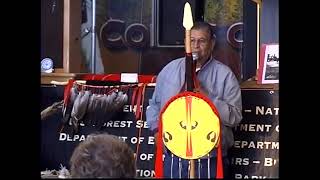
how are you good welcome to the tent of many voices how are you kids doing today good and what school do you kids come from where did you come from today St J St Joseph School now what grades do we have here are youall four just a fourth grade excellent is it good to be in the fourth grade kind of kind of uh-oh that doesn't sound reassuring is it the teachers no oh okay that's good that's good well welcome we are a traveling exhibit traveling along the Len Clark Trail my name is park ranger Aaron and we have been on the road since the year 2003 and we've seen a lot of school kids we've been around this country and seen a lot of different school kids and bringing them the story and a lot of the stories involve Native Americans because Lis and Clark met a lot of Native Americans that were living out west before Louis and Clark made it out there okay and today we have a special presentation for you given by Dan Jack who is a member of the C Indian tribe and he lives here in Washington in Ellensburg Washington which is near the middle of Washington Washington have you been there before you have it's it's snowing there isn't it Dan it is can you believe it it's snowing out there well Dan's going to be talking about the C Indian tribe and language and he works for the Central Washington University so let's give him a warm welcome here in the tent and with saying that I hand it over to you I uh I want to say that I really appreciate what the National Park Service has done for the last few years and that is to bring the exhibition on tour so I'm very appreciative of of their presence here today and things that that they've done for us and so while I'm talking to you there's going to be a slideshow going on behind me and the slideshow uh consists of 33 pictures of the C Indian tribe and U they'll be on for about 20 seconds or so and and then they're going to change I would like for you to use your imagination just a little bit uh this afternoon as I talk to you because I want to talk to you about our nation where they're from where they're located and a little bit about what's happened to them over the period of time that we're talking about but before I do that I want to say to you and what I've just said to you is greetings I'm grateful that all of you have come here and I welcome all as family so I'm very appreciative that you have taken the time to come come and visit and listen to what I have to say to you and hopefully learn a little bit about my people and my ancestors it's a very interesting story to me and I want to share it with you to each of you who maybe have thought about talking to Native America to the American Indian uh this is a wonderful opportunity for you to see some of the exhibits that the park service has available for you to look at so hopefully you'll be able to do that uh this afternoon how many of you have ever heard of the conation has anyone heard of the conation great okay so we have several people do you have any idea where they're located any idea if you would use your imagination and let's pretend that I'm not an artist but if we were to take a look at the United States and if we were to draw a map this would represent the state of Kansas now the state of Kansas over here on this map would be located in this general area right here and therefore we're known as a PLS Indian tribe ples Indian tribe tribe of suan descent and today there's a lot of talk about uh where our tribe came from a lot of people believe that we started in Ohio and others believe that we started on the Atlantic coast and that we were a part of what they call the woodlands tribes and the woodlands tribes consist of many others guapa the pones the otos the oage and they also think that the cause were a part of that now when I say to you the C Indian I'm going to be referring to our tribe in other terms as well the Kanza which would be we have the C we have the kza and we have another term or another way to spell it kza the reason for that is there are actually over 100 different ways to write and pronounce the name of our tribe but in 1868 the tribe was referred to in the government records as the call because that's the way that it sounded to the Frenchmen who were in the area that's what it sounded like to them cop in actuality it was Kanza so I prefer the Kanza spelling there are others in the tribe who prefer the C tribe but either one that's used or when it's used is referring to our tribe A Tribe that consists of today approximately 2700 members 2,700 members now when we were first discovered by a Frenchman from Canada the bourmont in the 1700s our tribe was located in the state of Kansas and in coloro adjoining Kansas and our lands consisted of our main tribal headquarters being right here and that today is Donan County Kansas located next to Donan or in Donan County Kansas we had lenworth aters Kansas City on over here into Colorado to Denver and our lands were very inclusive of these areas because they went all the way across and across the top roughly 2/3 of the state of Kansas and 20 million Acres 20 million acres and that was at the turn of the century in 18 00 does anyone know when Lewis and Clark came through when they started 183 184 186 that was the time frame when they were coming through the different lands so this is where they met with Lewis and Clark and that's at the Confluence of the the Missouri River and the Kansas River located within this land you had the Republican River you had all of the Sacred streams and the sacred Waters of the land and it was in this land that we refer to the tribe in their history as consisting of a Land of Plenty a land are a time of conflict and the future if we take a look at this area that we've outline then we would know as we looked at it and we thought about it we would know that that is where the blue stem grass grew the timber line the Riverbanks and all of these things were very important for our tribe and that our wealth was dependent upon the land that we occupi it's very interesting to note one thing and that was we never said we owned this land we occupied the land because Native America did not believe that you could own the land at the time which leads us to the problems that we faced with Lewis and Clark coming through yes we were part of the Louisiana Purchase yes we had occupied the lands for years but what's interesting is that to look at this land and to work the land our Indian tribe had 16 Clans the 16 Clans that we had each Clan had a job we had had one clan that was con that consisted of family members it's if each of you in here today if we were to divide you into 16 groups we would have 16 Clans that we could refer to and each Clan would have a job we had one clan who was in charge of the hunting grounds we had another clan who was in charge of harvest Ing we had another clan who was in charge of something else this is where our problems occur because when LS and Clark came through we began to learn that it was not uh what a lot of people think of it to today but it was a cultural conflict if brought about cultural conflict now let me explain what I'm talking about my ancestors were told that they were not civilized you know what that means not behaving but what else huh not willing to make peace or something well um my people were told they didn't have cth they were not civilized they they they lived a life that was not a life of Choosing by others because we could not speak the English language my ancestors could speak six languages but they did not know nor understand anything about English and for that reason they were not considered to be people my grandmother when I went to her and I asked her to teach me me the language she said no the reason she said no is because in 1873 when our people were removed from their lands they also were told that they were to give up the Native American lifestyle they were not to speak the languages or practice the Traditions any longer and she went to hcal Institute in the state of Kansas an Indian School and she was told to forget those things and to begin to pick up the traditions of settlers and so my grandmother would not teach me the language instead what she told me was you need to go to school you need to learn English and you then need to return and to come back and to talk to the youth just like I'm talking to you today and that you need to tell them what is right you need to do some teaching Dan Jack and I said oh you need as much education as you can come up with and get and every opportunity that you have to go to school you need to go to school and you need to learn because you do not want to be called uncivilized as I have been I didn't understand this I didn't understand what she was telling me because I like her I thought she was civilized but she was right I needed to learn and get an education and come back and teach the youth and so that's a vow that I made to tribe so what is this thing that we call culture and a cultural conflict with Lewis and Clark the language is one thing learning the C Customs is another and that's what we have tried to do as we have followed this journey making its track Across the Western portion of the United States we understand much better now than we did then of what's happened to Native America and the culture that we've learned since the time of of Our Land of Plenty so what did what happened with this what happened with it was our hunting grounds consisted of the lands in this portion and as the settlers were coming through they would cross the resour and they would come into our hunting area and they might say we've traveled far enough we're tired this is beautiful land why don't we just settle right here and so they would set up and maybe they would stop here and they would say well this looks like a pretty Place let's put our fences up let's let's farm right here let's let's settle right here well then the clan that was in charge of our grounds would go out and secure the areas and get ready for the hunting season and they would say uhoh where did these people come from and as they try to encounter these individuals they could not communicate with each other because we did not speak English and they did not speak the French or any of the language that we knew so we had a Communications problem that resulted in many other problems the result of conflicts friction and the result was for us is that we eventually lost this land and we eventually lost all of this land so we went from from having 20 million Acres that we would oversee and 20 million Acres where our people would go out and hunt and go out and try and protect we lost from that down to an area that consisted of 2,000 acres in a place called Council grow Kansas and that was in 1870 in Council Grove Kansas we had several Rock buildings that were erected for us and in Council Grove Kansas that's where we begin to establish uh ourselves and then the government told us that we were going to lose that because there were some people who wanted to buy that land well when that occurred we learned that we were going to move from Council Grove Kansas down here to another place and this place is where our people are today and this place is Oklahoma Indian Territory in 1873 700 of our tribal members moved from the state of Kansas into Oklahoma where we reside today we own today 1,500 acres and so we've gone from 20 million to 1500 acres in what is today present day Oklahoma we went from a Land of Plenty where we had 20 million Acres down to a land of conflict into today the future the timber the tall grass all remain at issue today in different meetings that we have with the people in Washington DC the result of this the result of losing the rivers and the sacred Ste streams brought about change for our tribe our kinds of men saw themselves who saw themselves primarily as Hunters Hunters of Buffalo those who captured the small wild life and the large animals on these lands in Kansas they uh they continued to do so until the the lands diminished and then as they diminished they turned to something that they were not used to and that was farming so it was hard for them to to make the changes indeed we went through these stages and the changes occurred time and time again the pressures of con conflict were brought about not only by the settlers coming in as a result of Lewis and Clark but also because of our own issues with the different tribes now what's interesting to me is if you take all of the tribes that occupied Kansas at one time or another which were many the Govern government said we're going to put you in this area down here in Oklahoma called Indian Territory and so as a result with our tribe we went from this large area like this where we could spread out into a smaller area down here the oage was our greatest enemy at one point and then over a period of time they became our greatest friend the paon E had always been an enemy of ours but became the greatest enemy of all and our tribe was located here in the pony was located here how can you expect to put two tribes together that had always been in a Waring situation and expect them to get along and after a while when after this had been done the government came back to us and said why are you squabbling why are you continually battling each other it was easy for us to try and explain but it was hard hard for the government to understand and this seemed to be the trend that was occurring and going on in the Oklahoma territory it came from the state of Kansas down there have been many different stories told among our tribal Elders does any do you know what a tribal Elder is what's a tribal Elder a chief or something you're close yeah you're close who who who has another idea ah really old in the tribe okay the older members of the tribe that's correct the older members of the tribe there's p sing P sing was an elder P sing was an elder in the tribe today you can identify them being probably 63 65 years old or older and uh that would be a tribal Elder and they hold some kind of of U uh a level of honor within the tribe as well in addition to being one of the older tribal members I was granted in the year 2000 well 1999 actually my Indian name which is Shin kakah hiiki Shin kakah hiiki means great leader of all men the youth The Young Ones the young ones in here today you would earn your status in the tribe by doing something great during the time of battle the Young Warriors the young tribal members would hold the horses as they went into battle and you would gain respect for things such as that so everyone had a role everyone played a part for the Chiefs we know that everyone was worried about losing the lands we had three different Villages and the three villages that we had we had a village that was called White plume's Village white plume was a this is white plume he was the leader of the half breeds of the C Indian wanted another picture of white plume and then we had fool Chief's Village and fool Chief's Village was the second V Village the second largest Village and the third Village was ruled by a person known as pag gashi and pag gashi was his his name easier for you to remember was Big John all three were Chiefs of the of the villages and the chiefs of The Villages Big John was probably the least effective there was another chief that came to be and that was Chief Ali gahu and chief aliga Wahu was the great orator of our tribe and chief aliga Wahu was 6' 6 in tall which was large during that time in the early 1800s and chief Alik aahu was the one who negotiated some of our our treaties but our treaties were broken on many occasions and those treaties we read today and we talk to the government about them one that we have right now is dated from 1825 and we're still trying to resolve some of the issues that that treaty brought about now our tribe went through through all of these different things they went through small poox infestations on two occasions they went through the many wars that they had with the other Indian tribes so we went through a time of Plenty a time of conflict and today we're going through the future now there have been several attempts that have been made by Hollywood and maybe some of you who've seen these attempts to bring to light the plight of Native Americans but most have failed does anyone know who Jim Thorp is have anyone heard of Jim Thorp do you have you heard of Jim Thorp okay well Jim Thorp was a very good athlete he U he's one example of many attempts to try and and bring out the good in Native America there was a movie made called Jim Thorp All America and it was one example of the many attempts of trying to bring out the good but it was a failure it was a failure because the information that was presented was not totally correct Jim Thorp was pinned up most of the time while he was in school in 1991 there was a movie that was released called Dances with Wolves and many of you may have heard of that movie and Dances with Wolves was one that was hailed by Native America to be Hollywood's best attempt at telling the story of the Native American and that best attempt was because it was told in the Native Americans own language it was told in their own tongue and I would have to agree that that was a very good attempt at telling the story of Native America now I'm sharing a lot of this with you today and I'm shortening some of it because because it goes into things that uh it it goes into a lot of depth and dates and times and history but I didn't want to bore you with that um but what I do want to share with you is that although we have gone through these things there's a poem that I would like to share with you this poem best exemplifies what the conation has been through what my elders have been through and the people that I have talked to and it's entitled tomorrow we have wept the blood of countless ages as each of us raised High the Lance of hate now let us dry our tears and learn the dance and chant of the life cycle for tomorrow dances behind the Sun and sacred promise of things to come from children not yet born for ours is the potential of truly lasting Beauty born of Hope and shaped by deed now let us lay the Lance of hate upon the soil today my tribe the people that I know and others as well are meeting the challenges that we have been faced with let let's look at a few of the success stories that we are aware of from the K Indian Nation comes Charles Curtis and Charles Curtis held the highest elected office of a public official in the United States from 1929 to 1933 Charles Curtis who was my cousin served as Vice President of the United States under Herbert Hoover Maria Tallchief for the young ladies in the crowd you may want to get to know about Maria Tallchief because Maria tall Chief still living today is an oage Indian who is a world-renowned ballerina from Fairfax Oklahoma she became America's preeminent dancer a prima ballerina and was named Woman of the Year by the president of the United States she has been honored for her International achievements and her proud Native American identity and she was named wamba woman of Two Worlds Will Rogers Will Rogers always said that he was first an Indian then a cowboy then a national figure now he is a legend Billy Mills who came from South Dakota reservation to participate on the world scene in the 1964 Tokyo Olympics as a champion and an individual Billy Mills has constantly challenged the barriers of culture Susan lefes picot Susan is the first Indian woman to become a doctor of medicine she devoted herself to the welfare of her people baseball notables C Mish who's a chak Charles Albert Chief Bender ojal Moses J Chief Yellow Horse upon e and the most colorful Native American baseball player was John lard Rosevelt Martin known as pepper Martin also called wild horse of the O AG I have the privilege of meeting an individual by the name of Ally Reynold who was called Super Chief a Creek Indian who played from the New York Yankees there are other professionals as well James Jarvis and MD who is a mohawk a pediatric rumatologist Evert rhods another medical doctor an Adjunct professor of medicine and a former Assistant Attorney General and Sharon James Smith Chaka chicka an anesthesiologist doctors lawyers Educators military personnel all have transitioned and contributed in a very positive way to today's society so I challenge each of you each of you who are here today to continue with your education I challenge each of you that to to further that education become involved for your people there are many ways that you can do it for those up on the front rows go to school learn the languages learn as much as you can in school today and get a scholarship for those who are adults we have lifelong learning opportunities continue that educational process because there are more people dependent upon the Youth of our nation today than ever before and each of you need to learn your history and your story and your background learn as I have it started as a yearning to know more about my people for me and my grandmother and what she went through then it became almost a hobby and still is today many Indian nations are experiencing the same thing that the K nation has experienced and that is the loss of the full- blood tribal member we have no longer any full Bloods living today the members of our tribe have met the individuals from all walks of life and we honor Those whom we respect on a yearly basis and we do so through the sacred rituals we remind ourselves of the history and traditions of our people we remember our friends and we learn about the fierce Warriors who have crossed over and into the circle that became our path each one of these individuals up here here have done that same thing we remind ourselves that if we ever tell their story we will do so just like I told this to you today and when we do we are reminded to say they are our friends we pray to our great spirit whose name is wak and we ask for their protection as they enter what we call and term the future life life and then we remind ourselves that now it is our turn to teach and to meet the challenges like our elders did we believe that as each day goes by small pieces of our body go into the air and they fall back to the Earth with the rain meaning in in essence we soak in our ancestors those issues and those things become very important to each of us so as I enter my study at my home and continue with my research to learn more people I can become engrossed and involve so much that I lose track of there's a second poem that I wish to share with you this afternoon and it's by ad copywriter Patrick o and it's titled nobody knows it but me and it best describes my experiences and it goes like this there's a place I travel when I want to Rome and nobody knows it but me the roads don't go there and the signs stay home and nobody knows it but me it's far far away and way way afar it's over the moon and the Sea and wherever you're going that's wherever you are and nobody knows it but me we have as a con ofation so much to be thankful for because of our ancestors and we want to reach out to each one of them and to thank them we want to tell them that so much has changed and that we are on what we consider to be the right path history does repeat itself in substance and there are decisions that still yet need to be made and issues that still yet need to be resolved both by the current generation and by Future Generations so we say to you and to our tribal members let's try and resolve these issues together not as individualists let's work together but I must remind you that as we begin our journey and start our task it will not be an easy task for we remain two cultures still divided how do we bring these cultures together that is one of the issues the challenges ahead are many but can be overcome the symbol of our tribe that has come up a couple of times on on the screen shows two writers on a horse and those two Riders represent one going into battle while the other has the bag in the air praying to the winds the colors that are included on that symbol are very important to the Kanza Indian Nation because our colors are red and yellow and green those are three colors that are are very important us in in addition to that they're praying to the South Winds because we are known as the con the nation or the con nation and the people of the south wind we believed an awful lot in the winds that blow the spirits into our direction to give us advice before going into battle so I've tried to share with you a little bit this afternoon about the cons of nation and our tribe I hope I've been successful there's so much to share with you I wish I had a whole afternoon there's just so much wealth of information that we've uncovered and it is Meaningful to me and I know that your history would be meaningful to you so I want to thank the National Park Service for giving me this opportunity and thank you for coming thank you very much thanks Dan was wonderful all right give yourselves a round of applause you were a great audience you kids were great very patient okay coming up next we have a presentation by Gary lent which is entitled Do no harm all right between now and then e for