Tent of Many Voices: M07220502TMB
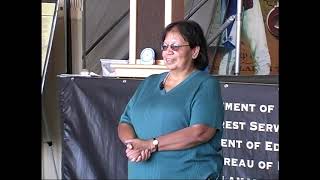
good afternoon everyone and welcome to the tent of many voices the tent of many voices is part of the core of Discovery 2 traveling L and Clark exhibit it's a multi- agency Federal exhibit the lead agency being the National Park Service as I said it's a traveling exhibit it started back back in January of 2003 he's been traveling since then and will travel through 2006 during the four years of the bicentennial the Lewis and Clark expedition what we do hear in the ten many voices as we bring in a wide variety of presenters to share with us different perspectives different voices both voices and perspectives on the leis and Clark expedition and voices and perspectives from those various American Indian nations that have been living there for thousands of years before Lewis and Clark came along and this afternoon we're going to hear from Germaine white who part of the confederated tri Salish in Cuttin tribes and she's going to share some of the history of her people and their connection to the Lewis and Clark expedition so let's please give Germaine a warm welcome to the tenam many voices thank you so much I'm delighted to be here today to visit with you a little bit about a tribal perspective on the Louis and Clark expedition uh as many of you know much that's uh known about the Lewis and Clark expedition has been written but for the tribal perspective so today I'd like to share with you a little bit um of information that was told to us by our elders who heard from their ancestors these stories so our Story begins on September 4th 1805 a large band of Salish indans was camped at a place called culi a large Gathering Place we now know it as Ross's hole in the bitet valley um on that day the people were gathering choke cherries because it was fall it was September that was the time to gather choke cherries and and pound them and dry them and prepare them for the for the winter stores of food the people were camped there not only were they Gathering choke cherries but they were also pasturing their fine horses on the Abundant grasses That Grew right there in the High Valley at the base of the pentler mountains there were over 30 camps over 400 people and over that number of horses that were there at that time it was a wonderful time of warm days and cold nights in that High Valley at the base of the pintlers in the bitet valley while the people were camped there a few days prior the scouts had seen a group approaching they brought the information back and there was discussion about this this band of Travelers that were clearly strangers they appeared to be a defeated war party they um they looked as if they were ill and they were hungry they were very pale um their me many of their horses were lame um and there was a great deal of discussion among the leaders uh among the elders and the leaders of the tribe about whether or not they constituted a threat to the well-being of the people and should be eliminated there were those many of those in the camp that said look at them they're ill they're wandering around they're lost um they present a threat to the wellbeing of the people there were those among the Salish that said look at them they're pitiful they're lost they're hungry their animals are lame they're pitiful we need to help them they're strangers they're passing through this much they knew about them there was a great deal of discussion and it was decided by the leaders and the elders that they would provide them assistance now in most non- indan accounts of History that's where the history of Montana begins however um Lewis and Clark were entering a world much older than they could have ever possibly imagined they were entering a world where people had lived uh a happy and contented life where they had uh subsisted on the natural Bounty of the landscape around them there really was no opportunity for them to understand the depth of relationship between people and the landscape um what Lewis and Clark entered what that band entered at that time reaches back to the very earliest beginnings of human history on this landscape most of the most of our stories tell about the making of This Place fit for humans who are yet to come our traditional stories are coyote stories and they tell about um the land form that were made about the resources that were there um and most of those places have Salish names linguists say that these names are the oldest names in our language in in English we call them archaic words uh some examples are Philips Berg we no longer use Berg in common English um it's a remnant of an of an archaic word we don't use Stevensville or we still say Stevensville for a town on the west side but we no longer use Vil in common language so place names are the oldest words in our language and they describe the landscape and the tribe's relationship with the landscape there are places like timum in the bitet valley or no salmon a place that we now know as L um there's another place in the bitat valley like Umi um the great Gathering Place or Ross's hole um another place in the bitet valley that um that has a place name describes a coyote story um um it's the place of the sleeping child or sleeping child Hot Springs now um it's interesting because many of these place names uh describe a very ancient landscape and um the coyote stories talk about um about the seasonal uh battled between warm and cold and the final establishment of the seasonal regimes we know now and most it it's curious because most of the stories that are told um very closely remember excuse me very closely resemble the geological um formations uh the ice age glacier Lake Missoula um and the final seasonal regimes we know now the animals that we have presently most archaeologists date that time to about uh 10 to 12,000 years before present um interestingly enough there's there's been a significant amount of archaeological excavation done at the Confluence of the Clark's fork and the Flathead River really in the heart of our homeland and those um those test sites have also been dated to about 10 to 12,000 years so for Salish people this was a landscape that um that the Explorers entered that tribal people had had a relationship with for a very long period of time and I think that maybe the uh Expedition had no way of really understanding that that relationship between people in place um in in many ways um the early descriptions of the landscape that um the Expedition entered was called a Wilderness you know sometimes they describe it as a virgin Wilderness and actually it was um it was not a Wilderness it was a land that was occupied and that was known by the people it was um it was known quite intimately and the stories that we have really talk about um as I said how long we've been here and the depth of relationship and the understanding of the landscape um lots of folks in Montana have been here multi-generations lived on the Family Farm And and understand about what it's like to to Noah place for multiple Generations but for Salish people their relationship with the bitet valley was really um closer to 10 or 12,000 years of relationship so sometimes we hear Lewis and Clark called um the core of Discovery and they were really less discovering than entering a very old landscape um the the landscape they encountered was abundant and it was presti it was a landscape that um that I think early explorers couldn't understand in many ways um because they really felt that the the people they encountered there just didn't have the sophisticated technology to destroy the landscape where in reality tribal values are for maintenance of a landscape um we're taught from the very earliest ages yet today to never take more than we need to never waste anything we take and always ensure that there's an abundance for future generations and in that way tribal people for thousands of years lived a sustainable um a sustainable way of life on the land the Salish people um that lived in the bitup valley are the most interior band of Salish speaking people at one time we were a very large Salish family there were there were many tribes and we lived in the entire Northwest of the United States over time as our numbers grew in order not to exceed the resources on the land more bands traveled further and further apart but for us the most interior band of Salish speaking people we have many relatives that live to the west of us toward the coast so there are Spokan cordelan Callis spels um uh calval okan aans and many other Salish speaking people the territory we occupied was an extraordinary large territory so not only did the people have experience on the land of great time depth we also had experience on the land in a very extensive um region of the um region of the Northwest the tribes followed a a seasonal way of life they gathered the abundance of the land that was available um we gathered beginning in the spring our earliest food was bitot followed by cus um in the summer we visited friends and celebrated and picked berries and dried them and stored them for future use we also um had fall hunts um over into the um over into these areas into the into the plains part of the state um into the Great Falls area into this the Three Forks area there were winter camps that were based there as well so the tribes had an extraordinarily long time depth and Al also a very vast expanse of territory they had a relationship with so Lewis and Clark when they stumbled into were really um were less than discoverers they were really visitors for a very short period of time and I like to talk about the time depth of people um because it really for us it puts the Louis and Clark expedition it it helps us put the Lewis and Clark expedition in a tribal in a tribal perspective so if you think about um let's imagine 12,000 years of occupancy on the land and imagine that as a 24-hour day and take that 10 that 10 to 12,000 years wrap it around a clock for um for a 24-hour day what that means is that uh Columbus arrived at about 10:59 p.m. on that day in the in the world of the Salish people and Lewis and Clark arrived at about midnight so um there was a great deal of time that that that the tribes had in this place before the Expedition and a great deal of history in the state um in in our region before the visitors and strangers came Among Us in the period just preceding the Expedition there were significant changes there were changes that happened rapidly and dramatically one of the first changes that happened was between the 1600s and the 1700s and that was the introduction of horse we acquired from um from our occasional allies to the south of us the shishoni people and um it had a profound impact in our way of life we were one of the first people in this in this region to have horse and it extraordinarily expanded our territory our Mobility our ability to hunt our ability to um to continue our way of life it was an extraordinary uh benefit to the people to have to have horse and natur naturally our enemies the black feet to the north of us had not acquired a horse yet so if you think about the power differential among among people that um occasionally had conflicts over um over competing resources um when you imagine that um Salish people had horse before any of the people in the the region the power differential was tipped way in favor of the Salish people as I said it provided greater Mobility um easier access to Buffalo to hunting um and all of the other foods and materials that we needed um however because it expanded the territory it meant that there was greater conflict between tribes and as they competed over resources in lands that were overlapping Aboriginal territory so about the time that this extraordinary gift the horse arrived among us there was also something else that that came Among Us that had a very different impact um as I said there um the people lived a life that was rich with the abundance but rarely did they have contact with strangers so and so they had not acquired immunity to European diseases and smallpox arrived and particularly small poox among all of the diseases had a devastating effect among the people some people say that five to seven out of every eight people died in a camp as a result of small poox historic um demographers say that about it at by about 1,800 the numbers of Salish people declined from perhaps 40,000 to anywhere between 15 and 5,000 it was a sign it had a profound impact but it it didn't just impact the Salish people it impacted people all across um all across the the Northwest and all across the region because we lived in communities that were very homogeneous we we lived together we didn't abandon um our ill or our elderly and um we lived in community so what happened was that when disease came into the community it spread like wildfire it's just like um when my when my daughters were at home it seemed like one of the girls would bring home um the flu just after school started and then my second daughter would get the flu and then pretty soon their father would get the flu and then you know they'd all be up and on their feet and i' get the flu well mercifully we're able to sustain um we're able to get by even though we we get occasional flu but with small pox there was really no resistance and the people died in huge numbers more than more than the people could grieve and bury individually it it had a profound devastating effect on the tribes um one of the other significant changes that happened during this time just prior to the expedition was um an interesting part of History Hudson Bay established um I'm trying to remember the name of the fort some of you historians probably know this Buckingham house on the Saskatchewan River at about 1870 and um prior to that time people had learned about um about non- indan people they knew that there were that there were white people but very few of our people before Lewis and Clark had had Direct experience with with non-native peoples the Hudson Bay Company um had a profound effect on us at Buckingham house because they began to trade Firearms with the black feet people our traditional enemies as a consequence of our um conflict over competing resources in territory it was um it sign significantly shifted the power differential again because when they acquired Firearms nearly 10 to 20 years before us that had a dramatic effect so there were there were huge impacts and enormous changes to the tribal World um the Lewis and Clark Expedition was sent by as many of you know sent by President Thomas Jefferson and he stated that um in the instructions he gave to Maryweather Lewis President Jefferson said the object of your mission is to explore the Missouri River and to find the best water route to the Pacific Ocean for the purposes of Commerce so these guys were really on a business trip they they came looking like a military Expedition but they were really on a business trip and they were there to catalog and prepare to appropriate tribal resources so for many tribal people the arrival of the Lewis and Clark expedition and the subsequent changes that occurred after that are really a dark part of our tribal history um they established a groundwork uh the the groundwork for um significant changes that happened to tribal people um and a fundamentally different way of life that resulted from um from all of the changes that came after the core of discovery and I I don't mean to disparage any great American Heroes but I really do want to provide what I believe is a balanced and honest and accurate telling of the story uh the story that remains to be told and that's that's the tribal perspective um the the Salish people were were really unaware of the Louis and Clark expedition's full objectives um it it was difficult for them to know um the Explorers spoke English they had french-speaking interpreters The Interpreter spoke one of the interpreters spoke to his wife who understood French and spoke shason and there was a small boy among the Salish that spoke shason and he translated the shishoni to Salish so imagine what happened when communication went through that many iterations of of translation I I'm guessing that very little was understood very um I I would guess that there was significant miscommunication and and great misunderstanding among the people um the results might have been very different in terms of misunderstanding one of the one of the greatest misunderstandings I think occurred when the Expedition arrived and um and the people offered them blankets they had no blankets they appeared to be cold their skin was kind of blue and and white and so they offered them blankets and when the Expedition arrived they they put them down on the ground and sat on them and the people were very confused because they had offered these gifts to them and and they chose to sit on them it was kind it was one of the first examples of of communication but miscommunication but as I said the people had had determined that they would be that they would be generous to these um to these strangers that appeared to be lost so um the Expedition clearly had um had need of horses and we had an abundance of of beautiful what um what Clark described as elegant horses um the stock was exhausted some of them were lame and so the Expedition gave them uh seven horses in exchange for um 10 or 12 of The Elegant horses that the Salish people had they also um and this is going to be really important to the Louis and Clark expedition a little bit further on down trail um they didn't know the trail so so they were provided an escort they were um they were shown on to the over L pass to go and meet among the nest Pur people um the Salish also gifted the Lewis and Clark Expedition with value food stores that had taken countless hours to prepare they gave them dried meat they gave them Roots they gave them berries they gave them food that would sustain them and it would take countless hours to replace them as well as the hides they were given um to keep themselves warm on their trip over the pass as they began traveling over the past they um they encountered every hardship That Could Be Imagined as as the Explorers said um William Clark or excuse me uh Lewis wrote after his return um most fortunately on our way within the mountains we met with a traveling band of they were Salish people going to the plains of the Missouri in quest of Buffalo and obtained from them an accession of seven horses to our former stock exchanging at the same time 10 or 12 to Great Advantage this ultimately proved of infinite service to us as we were compelled to subsist on horse beef and dogs previous to our arrival in the in the navigable navigable part of the cus cusi I have not the Leisure at this moment to State all those difficulties which we encountered in our passage over these mountains suffice it to say we suffered every Everything cold hunger and fatigue could impart so clearly the um the horses that were gifted to them were of huge benefit um not just for transportation but but for food as well as they traveled Clark also echoed the words of of Lewis at about this time I want to make sure that I leave plenty of time for us to discuss this um this encounter between the Salish people in the Lewis and Clark expedition I'm I'm just going to conclude by saying that many of the leaders were um were greatly um angered and and hurt by the subsequent events that happened um the after the um leis and Clark expedition there was a a a great concern that the kindness of the people had been exploited the welcoming and the generosity of the people had been um uh had been used and the people had been had been treated somewhat um somewhat badly this was a an ancient landscape and the people had had a great um relationship with the land and a and a huge fondness for the land and yet um there was clear misunderstanding and miscommunication I believe what our ancestors offered the Lewis and Clark Expedition was really an opportunity for respectful coexistence that that they knew the strangers were there they knew the strangers were passing through and they wanted they wanted to help them provide them some assistance and and hopefully provide that promise of of a way um another way of interacting with the people um when I was first asked to serve as a representative for the tribes and provide a tribal perspective on the Lewis and Clark expedition I met with our tribal elders and I asked them um what I should say and and what I should tell the people and at first they said you know this this isn't a celebration for us this is not something that we really want to participate in this is not um these people to us were not great Heroes um it this was the beginning of an opening to our to our land that um this was the beginning of the cataloging of our resources and appropriation of those resources um and they talked among themselves and some of those said nope we're not going to have anything to do with it and the others said think of our children think think of what they will learn think about what they will know if if our story isn't told so the elders sat down and worked many countless hours and told the stories that they knew they told hundreds of hours of of stories and those stories were recorded and a a draft was prepared and um the elders have just released and the culture committee has just released this book The Salish people in the Lewis and Clark expedition it's um it's really um a telling of the of the tribal story thank you and if anyone has any questions for Germaine please raise your hand I'll bring the microphone around so everybody gets a chance to hear them does anybody have any questions hi I I'm sorry I came late the could Salish now have a good oral history program don't they yes and the second part of that question is if they do does the communal memory and tradition of of Storytelling go back far enough to the Louis and Clark expedition thanks that's such a great question it reminds me of something that I left off that I had hoped to speak about um the tribe formed a cultural committee um approximately 30 years ago there were a group of middle-aged people in the in the mid 70s that were very concerned about the loss of language culture history and and many of them had been raised by traditional grandparents and what they knew was that their children um and their grandchildren were not able to communicate unate with their with the grandparents that the older people spoke Salish the young children spoke English and there was a huge disconnect so the middle-aged this group of middle-aged people that was very concerned and that that were fluent language speakers asked the elders to come to a meeting and ask the elders for guidance and Direction and said what shall we do we're things are changing we're we're afraid for our children they're losing their language and their history and um the elders came together and they expressed an extraordinary sense of gratitude they said we've been carrying the burden of these stories um and have have looked for somebody to pass them on to and we we have these stories that were given to us by our elders that was given to them by their ancestors and we're we continue to carry them but we don't see we they hadn't seen anybody to pass them on to so it was a wonderful Nexus between um between the Middle people and the elders and some very bright individual and I don't know who it is but some Visionary um chose to bring a tape recorder to the meeting and turn it on so we have approximately a thousand hours of recorded oral history interviews by Elders that you know many of them left us just after after that time so um we've got uh about a th000 hours of songs about a th000 hours of oral history so when we began this this project not only did we um look at the oral history tapes that the taped interviews but we also met with the elders we have today in terms of time depth most of those older Elders had parents or grandparents that had lived during a time um before there was there was significant non-tribal contact so at that time the stories were very intact and we have we have many hours of coyote stories that tell about the the formation of the place the um all of the um the resources the landmarks um how the animals came to be in incredible stories so we have um a rich Archive of information great question oh and and just to answer your last question some of the elders have have commented on what what they generally call openings um what it is when the tribal when someone comes comes into tribal land and there's a consequent change in in the traditional way of life Pete beaverhead said I believe it was in the mid '70s Pete beaverhead said um they hadn't even seen our land yet and already they hadd taken it um Mitch small salmon said um they came and they set Flags down on our land and claimed it and yet it was already occupied so um there was there were some early accounts of of what happened when early strangers came into Salish territory and did we have any other questions y all right Jermaine um could you um comment on the the book by uh Peter Ronan who was a traitor around I guess around the turn of the 20th century uh and which he talked about his time living with the SES and and particularly he said that there had been that that William Clark had fathered a child with this Anish woman and is that a story that's ongoing within the tribe was that a new book that is a story that's talked about um um yes there um one of the one of the culture committee staff said something about Louis and Clark were the first deadbeat dads they um left a child behind that they did not provide for and the Salish people did raise that child and we have a picture of um his grandchild in in the book as well um sakal Clark Jermain can you talk about uh land ownership I mean there were territories amongst the other tribes you were competing but what was the concept of owning land and land ownership in in traditional times there wasn't a sense of ownership we had a relationship with a landscape that was really very intimate it was not um uh you know I'm guessing it's a lot like people that have had multi-generational Farms you know they they take care of it because it was given to them by their parents or grandparents and they hope to pass it on to their children um the land ownership or the relationship between s people in the land was really um a very reciprocal relationship it was um it was based on reciprocity and um there was a great deal of abundance that was offered to the people but it was all held communally and um we as I said at one time we were a very large band of Salish speaking people and um we had primary camps um along the Flathead River we had primary camps in the bitup valley we had a primary Camp uh along the Sun River um in the Three Forks area um there were there were um at one time there were both um plateau and plains Salish people so we were on on both sides of the Divide um and you know in um in ecological terms we talk about um we talk about those areas um those biosystems where two different Landscapes come together like wetlands and and you know grasslands or something like that and and for us and those are extraordinarily rich in complex landscapes for Salish people we lived at the backbone of the world we lived at the very beginning of the water we lived at the very beginning of the resources and we lived on both sides of the Divide so we hunted bison um like PLS people we gathered Roots like Plateau people um it it was um you know it was like a SM boorg we took the we took the um an abundance we we took from the abundance that was all around us um and and we um felt a great deal of uh people knew the landscape the elders lament now is that our children are like Buffalo born behind a fence they have no idea of the Abundant landscape and the depth of relationship that that people had traditionally kind of a long answer what was the name of the book that you mentioned right at the end on the Indian perspective when was it printed um it came out two weeks ago it was um it's published by University of Nebraska press and it's called the Salish people and the Louis and Clark expedition yeah and um I understand the Press told us you can go you can Google it you can go to um like amazon.com and and get copies of it or you can just contact the tribes and we can you know we we have them as well but yeah I don't think I answered one of your questions did you ask me a complex question or a or a two-part question oh okay this the second topic I wanted to ask you about was the the attitude of the towards Clark slave York and whether he was treated any differently than than anyone else on the Expedition as he was with some tribes and and I asked that because when Clark talked to B about when they were preparing the journals Clark had said that some tribes that had not had much personal encounter with Europeans didn't treat York any differently than anyone else York might have been the determining factor for one of the significant determining factors that allowed the Expedition not to be eliminated when they entered Salish territory the people were very very curious about him there's um in our um in our ceremonial way of life there is there is a time where um occasionally a transformation happens and um uh charcoal will will be used to blacken the skin and there was there there was some question about whether or not this this person was a great um a great spiritual leader of the people whether he was the um the you know the the most profoundly spiritual person um and and leader within the group um so there was some question whether or not that that color would come off they were very curious about him extraordinarily curious about him and did we have any more questions for Germain oh yes we do good all right I noticed that you had said that you considered that the Salish were related to other tribes in the area and but how did you regard the black feet as being I I it seems as if they were the sworn enemies of almost everybody around but did you consider other native tribes like the black fate to be related to Salish or how was was no we're distinct there's no relationship they have a completely separate language and history and culture there's there's no relationship between Salish and cutney people and the black feet people um I think it was Desmet that called black feet the hell hounds the Rockies they were they were um uh they were Fierce Warriors occasionally we had temporary alliances but traditionally they were our enemies and it it's complex to understand the the need to protect resources for the well-being of the people and how it is that that when some when someone enters into your territory and makes an effort to uh to capture those resources how people will fiercely respond I mean if somebody came to your house to steal a child um I'm guessing you would be fierce in your retaliation of of that individual um for Salish people and and it's for Salish people it was much the same you know the the threat to the well-being of the people was was um was powerful and people we are known to be very hospitable very generous of spirit people but um we're also known to be extremely Fierce adversaries so the relationship between black feet was primarily adversarial and you know I I I really don't get this you know I I don't get the whole notion of War Warfare you know maybe it's a gender thing or I don't know you know maybe it's because I'm a mom um you know or an educator and so maybe because I come from a people that are really very very peaceful people and but so I don't get it so I asked one of the elders you know just to try to explain to me about Warfare because it it doesn't make sense to me um it seems contradictory to everything about our culture um the extraordinary art we produced the the generosity as I said um you know the love of children um the deep relationship with animals so why did we go to war and um finally in frustration he said you know it was a different time gerain it was a different time probably now people that were um probably now great warriors that were admired for their courage their strength their bravery would be in prison so it's just um it's difficult for me to really explain about Warfare and adversarial relationships very easily and particularly about our relationship with black feet you know I tell my black feet friends don't take it personally you know if if some of my relatives um seem less than welcoming it's just this long historic relationship we have well let's thank Germaine again for joining us here in the Ten of many voices thank you lmm L pesia thank you and remember there are programs here in the ten