Tent of Many Voices: M09200501TED
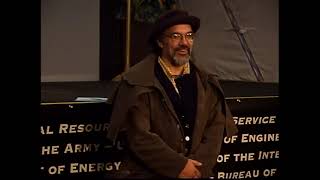
this is our performance our stage our uh storytelling this is the good tent really now this is a tent that travels with the core Discovery 2 we're traveling exhibit traveling the entire Lewis and Clark Trail and we've been doing so for three years now and we still have one year left to go now inside the tent of many voices we invite in a lot of different presenters different backgrounds different things to share and tell all of us while we're out here in the in the Ten of many voices so today I'll stop talking and I'll turn it over to our real presenter for this morning i' would like to introduce Mr solo green he is the education specialist for the NES first tribe and he's going to be sharing about yesterday today and tomorrow a little bit of their cultural history please welcome Mr all right thank you it's the honor and privilege to be here this morning and it's good to see everybody um I I'd want to ask you guys first if you would want me here or up there so you could see me better it's your choice I wanted to leave it up to you guys you guys want me up there all right all right is that better all right first of all I just want to kind of take you back to part of our history before Lewis and Clark how things were prior to the arrival of Lewis and Clark and the settlers not only to this area but to the United States because as as you all know we we read in textbooks and things like that that Columbus discovered America and hopefully we're starting to over come the barriers in a misperception of our history that's been written so as you all know when Louis or when um Columbus came to the United States he found native people here and as more and more people start coming to United States our people were pushed over towards the West more and more and more and more but on prior to Lewis and Clark and even before the settlers start coming here native people are spiritual people I need to let you guys know that right now native people are spiritual people we're not religious people we're spiritual people what I mean by that is we have a place down by laway do you guys know where laway is at some of you all right we a lot of the students are you're from Clear waterer Valley is that correct all right it's good to see you guys here hopefully someday this year hopefully I'll be able to come to your school and present to your school as individual even classes or at Pep assembly or what it is but um there's a place down in laway called Thunder Hill and one thing I want I need to clarify is there's a difference between spiritual and religious people spiritual people are are people that rely on a career Creator a great spirit a Hana as nesp people call it and religious are religion is more ceremonies specific ways to do specific things but prior to the arrival of settlers and non-native people to this country we had people within our tribe the nesters tribe and also people from other tribes there was there was a prophetic person in every band every every village and every tribe I need to make that clear there was a prophetic person and what a prophetic person is is a person he was a spiritual person that would fast and he would pray so he' go on for the nest purse or nimi poo as we're called this guy his name was Thunder eyes he'd go to Thunder Hill and he'd stay up there and he'd fast and he'd pray there's two important visions that he saw one of the visions that he was pale pale skinned people but they had upside down heads and he didn't really know what that meant and he shared it with their people you think about that pale skinned people with upside down heads now you look at some of our non-native people some of your grandpas maybe some of the older people where a lot of times they start losing their hair hair on top of their head right but they still have their mustache they still have their beards so that's what he saw he saw non-native people with pale skin but their heads look like they're upside down but it really wasn't upside down what it was was their beards were down here and they didn't have any hair on top so they thought thought their head was upside down but really it was just regular people but they had lighter skin and one thing I want to kind of make sure that we're we're on the same page today is it shouldn't matter what color we are we're human beings we're people for me I'm proud to be a nest person I'm proud to be a nimi poo and you should be proud of who you are where you came from and what you're doing so I want to make every I want to make that make that clear today that our color doesn't mean anything it's just pigment in our skin it's just melanin in our skin that makes us dark or makes us light and it shouldn't matter what color we are we're all human beings that's the most important thing that we're going to get out of it is we're all human we come from different places we do different things and that's all right it's okay to be different but the other Gene that he had was about a deer he had a dream about a deer but it was bigger than a deer and it had spots and he didn't know what that meant did some of you know what that was it was a horse it was a Appaloosa so this guy Thunder eyes he went up to this place on Thunder Hill and he had he had this Vision prior to the settlers and non people coming here and prior to the Appaloosa coming to the nest purse But as time goes as history goes like I said more and more settlers they start coming to this area they start West and then um so they started this with Lewis and Clark in the discovery they start coming back this way to check out the land to see what was going on in the west because Pastor bedu was a place that they never have gone before for so they start their journey and I I'm sure you heard a lot of stories and a lot of the history already but I'm going to say it more from the cultural perspective a lot of times in the books that we read the stories that we read it talks about Native Americans in the past tense it talks about Native Native Americans as they were or Native Americans was but one thing I want you guys to be aware of today and I you guys know that the NES Pur the nimi Po and Native Americans are still here today the other thing that books talk about a lot are that Native Americans are savages they're Warriors they're murderers they're killers and all that other kind of stuff but to tell you the truth it was actually the opposite of that the prime example is is when Louis and Clark met up with three three young nesters or nimi poo boys up by we at by Pierce area when they came and they met Twisted hair in his band at at Pierce in the weip area see the nesters people they didn't know what to think they didn't know what to do because they've heard of it they've heard of the the non-native people the settlers coming to this area then when it actually happened they didn't know what to do they noticed they had had a young native woman with them and you guys know who that is right sacka Jia was with them but you know what we hear a lot of stories about saak Jia how great she was and the things that she's done but one of the things that we need to clarify today is that when the nest purse and Louis and Clark met up that Prairie The Nest Pur weren't really sure what to do should they attack him should they kill him because sakaia was from a tribe that is a a enemy tribe of the nest purse but there's one person a nest purse lady who was taken by fur Traders and other people in a different area actually she was taken from a different tribe the black feet tribe and the black feet tribe took her and traded her to fur Trader she eventually made it back to the nest Pur tribe after staying many years with the fur Traders she made it back to the nest purse to this encampment her name was wakas I'm not sure if you guys heard of her before but wus was the main one that helped save Lewis and Clark that helped save sacka and other people because like I said the nest Pur weren't really sure what to do with them they didn't know if they're going to be enemies they didn't know what to think of them because really after they made it through the bitter Roots Louis and Clark they weren't really goodlook people they weren't really muscular they were skinny they were pale they didn't know what to think but it was wack Kus that told them it's okay they took good care of me and so they listened to her there's Twisted hairs man they listened to her and they said okay so they fed Lewis and Clark they nurtured them they provided for them they even gave up their own beds to them now if we're if we're Savages if we're Killers if we're murderers with something like that have happened no it wouldn't have happened so there's we need to clarify and correct some of our history that's talked about the nest purse about the Native Americans about being Killers about being Savages and all those other negative words that are placed on our people so one of the things I want you guys to remember is wack was one of the main ones that helped save Louis and Clark but the next person didn't only provide for them or nurtur them what they did is they showed them the way because they were Louis and Clark they're going to the Pacific Ocean and instead of just pointing in a direction Twisted hair and his band and his people they showed him the way they actually took him all the way down to the Columbia River and cilo Falls so it's really important that we remember that that the nest purse was really a big part of why they made it and how they made it to the Pacific Ocean but during this time one of the things that was shared with the nest purse was the good book do you guys know what the good book is the nest purse refer to the good book as the Bible so Louis and Clark had a Bible with them they shared some of the words some of the ways with the nest Pur people and chief Jo old Chief Joseph and his band some of the Chiefs they really liked it but after Lewis and Clark left they went to the Pacific Ocean then in 1806 they came back the nest purse provided for them they nurtured them they helped them again and they help help guide them in the right direction back in the same direction they came from Louis and Clark they went back to Louisiana where they came they went back to St Louis they made it back there but that good book was still on a mind of Chief josea some of the nest Pur people it was interesting to them in 1831 The Nest purse they sent four Warriors back to St Louis to find Louis and Clark to find the good good book so those four in 1831 those four Warriors they headed on their way back to St Louis two of them were killed on the way over one of them was killed from sickness as they got there the other one black ego he made it back to the Salmon River but he was killed at at the Salmon River before he made it back here but since they made it over there the settlers the people that Lewis and Clark were reporting to they sent missionaries back here 1835 there were missionaries right here on a nest Pur reservation but one thing that the nest Pur noticed was that there was a difference between a missionaries and what was talked about in the Bible or the good book the way they treated people was different in a Bible you're supposed to respect all people respect all things treat your neighbors as yourself and we all know that part of it but the missionaries what they did to our native people to the nesters people is is that they whipped them if they spoke their own language they couldn't dress their traditional ways they couldn't practice their religious ceremonies they couldn't go sweat they couldn't do a lot of their their cultural and traditional things if they did the missionaries would whip them down in spalon Idaho there's a tree it's called The Whipping tree like if the nest purse they spoke their own language they'd be tied to that tree and they'd be whipped because they they spoke their own language but we think about some of these things that our people have gone through what was good for the non-native people with leis and Clark coming this way making it to the Pacific Ocean making it all all the way back there was also a hindrance to our people you look around here today you see what we have we have beautiful buildings we have highways we have beautiful cars we have all this thing all the material things that you could ever think of we have technology we have cell phones we have computers we have iPods we have all those other kind of things but it also took away from our ners people our native people one of the things that's really important to Native people is the land there's a quote from tuuu he's a great Nest Pur Chief from the dreamer Faith his quote was the Earth is part of my body I belong to the land out of which I came she is my mother you think about that the Earth is part of my body I belong to the land out of which I came she is my mother you think about Native Americans you think about the nest purse the nimi poo we lived off the land back then we lived off the land today we still live off the land we go hunting we go fishing we go dig roots and Mer berries and medicines and things like that so we're still gatherers but our reservations have shrunk we don't have the land that we used to have we all heard about the the wars the 1855 treaty Wars the 1863 fre Wars gold being found on a nest Pur reservation down by orino so there's a lot of things that happen to our people and there's a lot that was taken from our people but we're still here today there's things that are hindering our people that there never was in lives before things like drugs things like alcohol domestic violence team pregnancy all this other things that are hindering our people and we're still battling it but one thing I want to share with you guys before I before I end my presentation this morning is our people have survived the treaty Wars they survived the boarding schools the forced religion they survived the social services and Bia taking our children from our homes they s they survived all these things were surviving drugs and alcohol domestic violence there's a transformation and a movement going on amongst our native people today and that's something we're proud of we're changing our ways we're starting to go back to our culture our tradition and we're not only survivors but we're Overcomers our people are overcoming the things that have been placed on them we may not look like it because we wear clothes we drive cars we live in houses and things like that but we're still cultural and traditional people and we're not only Overcomers we're conquerors we're going to conquer drugs and alcohol we're going to conquer domestic violence and those other things that hinder our people but today it's a honor and privilege for me to be here I want to thank you guys for giving me this time but before I end I want to honor you because it's an honor and privilege for me to be here and none of us in here are better than and a person that's sitting next to us I'm not better than any of you out there we all have goals we all have dreams we all have visions we have different gifts different talents different abilities and you need to remember that we're all equal but we have different things that we're blessed with but before we end today I want to sing you an honor song from me to you and I want each and every one of you to know that that I love you a lot of you don't hear all the time but I love you I care about you and I want to be here for you one thing that I do I travel throughout the United States I give presentations about our culture about our history about who we are because I want people to get the right history I want to clarify the history that's been talked about us because we're not bad people we have different colors we have different beliefs but we're the the same on the inside our heart should always be the same we need to start looking at the heart not at the outward appearance but I'm gon to sing this song for you as I sing this song I want you guys to close your eyes some of you in here aren't very old but some of you in here remember the stories that your parents told you the stories that your grandparents told you some of you are going to live to be old people and that's going to be great because some of you are going to pass on what you heard today you're going to pass on that on to your children to your grandchildren maybe you could educate your parents or your grandparents of what you heard today but as I sing this I want you guys to close your eyes I want you to think about your life think about your parents your grandparents I also want you to think about where you're going and what you're doing in your life today because you're going to make make a difference in this world each and every one of you are going to make a difference but I'm going to sing this song and that's from me to you as my gift so when I start singing I would just want you to close your eyes and think about who you are where you're going and what you're doing yeah up up thank you and we' like to thank you very much for coming in today and sharing what you had to share with us did you guys have fun you guys like that song at the end yeah all right well I'm going to now I got got to split you up into a couple different groups so I'm going to call out some group numbers and I want people to raise their hands when you hear your group number first group numbers are two and three where's two and three at two and three okay two and three Ranger Aaron in the back is waving her hands in the air jumping up and down trying to look tall she's back there right now and she will take you over to the traditional games area okay you guys are going to stay seated now how how about group four where's group four at group four is right here group four we're going to turn around and we're going to go hey Laura really loud one two three hey Laura Laura right there she's going to take group four over to the Tepe over there all right now how about group five group five is over here all right group five she doesn't know this yet but group five for three years so we're having a lot of fun actually in here in our ten of many voices we invite in a lot of different speakers a lot of different presenters with different backgrounds different knowledge different ideas different opinions on the Lewis and Clark expedition and we do so in hopes to paint a really good picture for everyone else to get a good idea on what really went on those 200 years ago and what's going on today 200 years later in some of those same areas so with all of that said I'd like to introduce you to our next presenter our next speaker he is Mr solo green he is the education specialist from the npers and he's going to be talking about yesterday today and tomorrow some of the culture and the history behind his tribe so please help me welcome Mr Green thank you it's a it's an honor and privilege to be here to be able to present for you you about a little bit about our culture a little bit about our history and who we are today my understanding is that the students that are here today are from Clearwater Valley is that correct and you're sixth seventh and eighth graders is that right all right I just need to make sure that we had the right group in here but um like I said I'm blessed to be here today I going to take you back prior to Lewis and Clark of what what life was like prior to Louis and Clark I just got done presenting to some younger students but with the knowledge with your background I could go in a little bit more depth in a little bit more detail because you're older and that's respectful to be older hopefully that's one thing that you guys are able to do to your upper classmen to your teachers to your parents is be respectful one of the things that was taught and handing down from generation to generation to our people is to respect all people in all things when you take something from the land only take what you need and nothing more so with that I want to take you back prior to Lewis and Clark prior to 1805 even before Columbus or when Columbus arrived here on United States in America in our te in our textbooks in our history books and things like that we always hear that Christopher Columbus discovered America but hopefully we all know now that he didn't discover America because native people were already here as more and more settlers start coming to this land start coming to this great nation to this country more and more of our native people were pushed West a lot of the lot of the tribes back on the East Coast they're already put on reservations we lost many tribes at that time because they were collaborated as one and there were many different tribes that's one thing I need to clarify to do I need to clarify today amongst the nest Pur a lot of people think Nest Pur were just one people that lived in one area but the nest first people they lived in this area right here they lived up by Clearwater Valley by kuski they lived up there they lived down by rigin by whitebird by the Salmon River over by WWA mountains over by T canon in Washington even by lap way so we had our our tribe and our people they were located throughout this Northwest prior to 1855 the N first Rome land that was about 4 14 million acres of land that the nest Pur used used to utilize as their own that was prior to 1855 after 1863 our land was reduced from approximately 14 million to 7.5 million now our land is only about 750,000 Acres but prior to all of that information that I just shared with you one of the things that our native people used to do in the nest Pur and namei PU people used to do is they used to be spiritual people they used to pray they used to fast to seek Visions because back then we didn't have computers we didn't have satellites we didn't have technology to tell us what the weather was going to be like we didn't have these other different kind of things to let us know if a storm was coming in see now with technology today you could watch a person they could keep an eye on us today from Washington DC with the technology they have today but back in that time when leou and Clark start traveling when they start coming back West they could only document things on paper the places they went the things they used to do but prior to that the nest Pur the native people they used to seek a vision every tribe Every Nation every village they had a prophetic person a prophetic person is a spiritual person that would go fast that would pray he'd go in a secure place just for him sometimes he was on mountaintops sometimes he was away from everybody else but he had fast and pray to get a vision down in lapa there's a place called Thunder Thunder Hill a place where this guy named Thunder I used to go pray and fast to get a vision for our tribe for our village for our nation one of the things that he saw prior to Columbus prior to Lewis and Clark was he saw pale skinned people pale skinned people non-native people but their heads were upside down he didn't know what that meant he didn't know if they were ghosts he didn't really understand it at that time but a lot of you in here you have grandpas you have dads that don't have hair on their head a lot of them they still have their beards they still have their mustaches but at that time that's what he saw he saw pale skinned people non-native people their heads look like they were upside down but their they all it was was they lost their hair on top and they still had their beards and their mustache so it made it look like their heads were upside down but it weren't they just didn't have hair on top of their heads the other Vision that he saw was a a white deer but it was bigger than a deer and it had spots do you guys know what that was it was a horse it was a Appaloosa the Appaloosa was very important to the nest purse people prior to having the Appaloosa a lot of the roaming a lot of the migration that they had to do was by foot you even utilizing dogs but after they they got the horse which was in the probably the 1700s they were able to roam further they were able to go different places to trade to hunt to fish to gather to do all those kind of things but that's one thing I need to clarify today is that Nest Pur people they didn't they weren't St stationary people they moved from area to area depending on the season depending on their need because we all know hopefully we all know there's a good time to go hunting and a bad time to go hunting a good time to go fishing and a bad time to go fishing there's only certain times of the year that roots and berries and vegetations and cultural medicines were grew at that time so hopefully we all know that so that's one thing that the nest person native Nest nimi used to do is migrate from area to area depending on the season so we we kind of get a picture of the History part of it there's a a nest Pur Chief from the dreamer Faith his name was tuuu one of the quotes that he's really famous for is about the land his quote says the Earth is part of my body I belong to the land out of which I came she is my mother so you think about that the Earth is part of my body I belong to the land out of which I came she is my mother the native people and an esper people we relied off the land we survived off the land what we did to the Earth what we did to the land we also were doing to ourself remember from the beginning I said one thing that was passed on from generation to generation was that we were taught and raised to respect all people and all things only what you take only what you need take what you need and nothing more so remember that but in 1805 Luc and cork they made it to the we up the area at that time when they arrived there The Nest purse they didn't know who they were they didn't know what to expect they heard about this people coming but they didn't know what to do we all know there was a native person a native woman with Louis and Clark do you guys know what her name was saaka Jah did you guys hear about another person a a famous person according to the nest purse well known according to the nest purse that helped save them do you guys know what her name was yep wack Co she was the lady that really saved Louis and clar that saved saaka Jia saaka Jia belonged to a enemy tribe of the nest Pur so what really what wakas does what that mean her name means is return from being captured or return from being far away wus was captured by the black feet and she has traded from the black feet to some French fur Traders but she eventually made her way back to the nest purse after several years and she was at that time she was sick she was ill and the nest Pur people they didn't know what to do at the time they didn't know if they were to fight them to fend them off or what they were supposed to do but it was wack that said no they're nice people they were nice to me so instead of killing them so instead of fending them off or chasing them away they The Nest purse accepted them they took them in see we all hear about the 1855 treaty that set up the boundaries of the nest Pur reservation but really the treaty that they had with Lis and Clark was a friendship treaty in that what they did is they exchanged gifts they exchanged material things saying that from here on out we're going to be friends we're going to be respectful so at that time when leis Clark first Came Upon a nest purse The Nest purse they provided for them they nurtured them they took care of them they didn't only show them where to go they didn't only point in the direction of the Colombia or Columbia River and a Pacific Ocean they actually took them all the way to the Columbia River to Salo Falls see that kind of goes against our history and against our books and the things that we were taught and raised with as native Americans being Savages being Killers being murderers and all that kind of stuff but to make things right to clarify our history The Nest Pur the nimi pu and Native people they weren't killers they weren't Savages they didn't kill people just to kill people so that was one example of the nest purse showing these showing Lis and Clark how to live how to connect with each other see I stand up here today and I meet I see some other native people out in the crowd today but I'm a little bit darker than you and that's all right that I'm a little bit darker we're all different it doesn't matter what color skin we have we're on this Earth together it's not about the nest purse it's not about the nimi poo it's about human beings we're all human maybe we look different but that's okay to be different Maybe we think different but that's okay after Lewis and Clark came here one of the things that they shared with the nest purse was the good book you guys know what the good book is the Bible the good book was the Bible they shared the Bible with old Chief Joseph some of the other band some of the other Chiefs and they really liked it so as they showed Louis and Clark to the Pacific Ocean and to the Columbia River and now every return back in 1806 they also provided for them they provided horses they provided clothes food and all that other kind of stuff they needed to make it back over the bitteroot mountains in 183 in 1831 The Nest Pur Chief Joseph and some of the other Chiefs they were still curious and they wondered about the good book in 18 31 they sent four Warriors back to St Louis to find Lewis and Clark to find out more about the good book on their way to St Louis two Warriors died one Warrior died while they were there and one Warrior was killed on a at the mouth of Salmon River by the black feet so the nextest pur they were interested in the good book but in 1835 since two of The Warriors made it there they let them know what they were looking for the United States government they sent missionaries here so in 1835 there was missionaries set up in lap in walaal in the surrounding areas to help teach the nesters Native Americans about religion but remember what I said from the beginning is that nesters and Native Americans they weren't religious people they were spiritual people there's a difference but how these missionaries were treating The Nest purse was totally different from what was being taught or what was said in the good book The Nest purse they weren't allowed to speak their own language they couldn't dress their traditional way they had to cut their hair they had to wear uniforms they couldn't practice their their religious ceremonies or the traditional ways if they did they were whipped there's a tree down at baled in Idaho where they were tied to It's called The Whipping tree just because they spoke their own language it'd be tied to this tree and whipped so after a while after several years of this The Nest purse they said we don't want this anymore we don't like this religion what you speak is different from what the good book says you treat our people with disrespect you whip them you spin on them you're showing them bad things our people aren't like that our people were raised and taught to respect all people and all things but after the missionaries after the forced religion our people had to go through boarding schools at these boarding schools our people they were whipped they were abused they were spit upon some of them were even raped so there was a lot of bad things that happened to our people with these the forced religion with the treaty Wars with the treat trees the loss of the land the loss of the natural resources loss of our people today some of the things that we're faced with some of the things that hinder our people today are drugs alcohol domestic violence teen pregnancy all these other kind of things that hinder our people but not only my people they hinder your people see this isn't part of our culture this this isn't part of our ways but but it's something that we picked up we lost thousands and millions of acres of land because some of our people they started drinking they liked it and some of some of the non-native people they' buy land cheap from our people because they wanted some they wanted more alcohol so today some of the things that we're faced with like I said are the drugs or the alcohol domestic violence teen pregnancy disrespect but one thing I want to share with you guys today and let you know is that we have survived these things we survived the treaty Wars we survived the loss of land we survived being placed on reservations the forced religion the boarding schools we survived it we're surviving drugs and alcohol domestic violence but we're not only surviving it we're overcoming it our people our survivors we're Overcomers but more import more important than that we're conquerors not only native people but you and here some of you in here have been hindered by the same things maybe not you specifically but maybe your parents your grandparents your older brothers your older sisters and I want each and every one of you in here to know today that you're special all of you are special every one of you in here is unique you have something to provide for this world for this nation for your community for your NE for your neighborhood for your family so never get down on yourself always pick yourself up always feel good about who you are we all make mistakes we make bad choices we make bad decisions but pick yourself up keep going don't ever give don't ever get down on yourself don't ever quit don't ever give up as as long as you do everything that you can that's all anybody could expect of you but before I end today I want to share a song with you a honor song for you because it's an honor and privilege for me to be here and I thank you for being here I thank your teachers your school district your superintendent for allowing you to be here today is the educational experience not only for you but also for me I know there's a lot of people that we haven't really seen eye to eye from the beginning we always had our our divisions our separations our own thoughts but today I hope we start taking down those walls I hope we start taking down those divisions those bad feelings those pains and those hurts that our people have felt for hundreds of years so today in that process it's part of the healing process not only for for me but some of you I'm going to sing an honor song for you as I sing this song I want you guys to remember who you are where you came from and where you're going I want each and every one of you to do the best that you can from here on out don't take things for granted respect your mom your dad your brothers your sisters your teachers your classmates because we're all here together and that's what's the most important thing is that we're people we're human beings we need to do things the right way for the right reason but today as I sing this song I want you guys to close your eyes I want you to think about your lives I want you want you to think about what you're doing where you're at and where you're going because we all have a plan but as I sing this song I want you guys to please close your eyes and just think about those things I talked about h H yeah yeah yeah yeah you all right and we'd like to thank you very much if you please join me in one more round of applause to thank Mr Green for all that he shared with us today great so did you guys enjoy yourselves you having fun so far you know what I don't know about you but next is my favorite time of the day you know what time it is for next yeah that's my favorite time so what we're going to be doing now is I think you'll be walking back over to the front about where the bus has dropped you off and that's where they'll pick you up and bring you to your lunch spots okay so if you