Tent of Many Voices: Mark Weekley on TOMV
Hello, I'm Mark Weekley, superintendent of Lewis and Clark National Historic Trail. This is my 15th plus year as superintendent of the trail. I'm here in downtown Omaha, Nebraska. My backdrop is the Missouri River looking north towards Iowa. I am a white male with thinning hair. Well, actually not much hair on
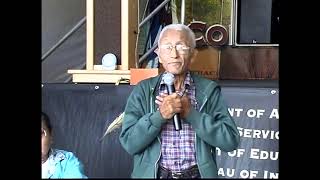
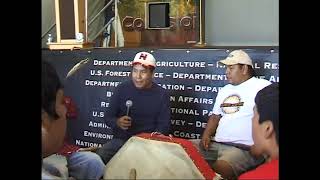
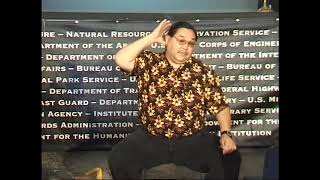
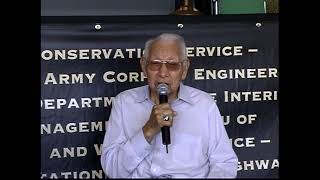
top anymore. What I do have is whitish blonde and I am wearing a National Park Service uniform which consists of a gray shirt, a green tie and green pants. Well, the most recent teneed many voices project and in order to understand that you got to go back to the beginning and the be beginning was 2003 2006 with the Louiswis and Clark bsentennial commemoration under the leadership of the superintendent at that time Gerard Baker. A venue was created called the tent to many voices. This amounted to a stage and a tent and this was set up so it could travel and be transported across the trail and across the country. And the genius behind the
ten of many voices is that speakers were invited to come in and they were given an opportunity to speak in an uncens unc uncensored format. This was particularly valuable for many many tribal speakers and indigenous people coming in and telling their stories and their knowledge about the Louiswis and Clark trail. And what our project is now is to continue a multi-year effort going back over 10 years to make these tapes and videos available to the public as easily as possible. Initially, these were available through archives. National archive has a set. We also created a
website called lc-tribal legacies.org where you can see many of the video recordings, but not all of them. This project that we're celebrating and excited about now represents the the kind of the final phase of making the stuff available so that they're readily available on the web that they're closed captioned, audioescribed and easy for people to get to. And I would have to give out a a real shout out to our leader and manager at Lewis Clark National Histo Trail for integrated resources stewardship, Dan Wy. He has been passionate about this for over 10 years and I think without his persistence and without his passion, the project that we're at today would not have been achieved. So Dan, let me say a sincere thank you to you. Really
appreciate your efforts and all your hard work and keeping this important project in the forefront and helping us keep our promise to all the many presenters. Thank you, Dan. I think the legacy is maybe most important and most significant for the fact that the tenement many voices really embraced and acknowledged the need to when you're talking about history, when you're talking about historical events and circumstances and people, you need many voices talking about it, you need many perspectives. And while that is kind of well understood and and kind of common sense in the park service, we talk a lot about, you know, facilitated dialogue, inclusive interpretation. 20ome years ago when this project was started and these recordings were started, that was not the norm. In fact, if you go back to
the bsentennial of our nation in 1976, uh it was referred to as a celebration. Gerard Baker came forward and led this effort to bring in tribal speakers and other experts and and individuals and citizens to talk not being censored and to start this process where we're going to have open honest dialogue about historical events. And it was George Baker who insisted that the Louiswis and Clark bsentennial be called a commemoration, not a celebration. And recently I heard some conversations and some presentations about people preparing for the 250th uh anniversary events related to our country and the National Park Service and they're saying and we're going to call this a commemoration. We're not going to call it a celebration. And so I
think in many ways a lot of the things that were started with the Louiswis and Clark Trail have expanded and actually are becoming commonplace processes now. And people have no idea that a lot of this goes back to Gerard Baker and the Louiswis and Clark trail and the Louiswis and Clark commemoration and the standards and expectations that were put in place then are now kind of the norms of today. I think the answer is definitely yes. The the legacy and the perceptions of Louiswis and Clark has changed. I think what has happened is we look at Louiswis and Clark in a much more holistic way. We recognize them as real
people and I think we've taken them down off maybe the pedestal they were on as these two great heroes that went out into the empty uncharted wilderness and recognized them as as part of a very complex process. Uh and not all of it positive. Uh both these men owned slaves. York was a slave, an enslaved man on this expedition. And I think that process or the process of understanding history in a fuller, richer manner matters a great deal. And
I think that is one of the things that's changed. We we understand the members of the expedition. We understand the consequences of expedition which in some cases were not positive. Many members of tribal nation refer to it as the beginning of the end for native people in the west. Uh many tribes continue to thrive today but they suffered greatly with westward expansion. And so I think
we need to be able to look at all those conversations and look at history and look at the full spectrum of of really what the expedition was, what it wasn't, instead of looking at it as some kind of a a glorious event led by two charming heroes. It it's much more complicated than that. And I think that is one of the huge legacies of the tetamy voices to be able to look at the full richness and complexity and some of the uncomfortable truths associated with history in the history of the expedition. I think coming out of the bicesentennial and the tenement many voices has had a significant impact on how we Louiswis and Clark National Historic Trail operates today. I think again going back we had kind of a simplest somewhat romantic view of the Louiswis and Clark expedition before that time and now we look at it through eyes wide open or hopefully wide open.
Uh there has been also a great deal of research that was done in preparation for the bicesentennial as well as after the bicesentennial and I think that has affected how we are able to look at things. uh the the book regarding the the letters from uh William Clark to his brother complaining in some cases about uh York is very insightful and it changes our understanding of that. And so as a result of this we are engaged right now in a project called the York project or possibly we may call it big medicine for the name he was given by tribal people. Uh we are also involved in a project called uh the Chicago project. Same thing we're trying to take a hard look at Chicago. And recently uh a book was
published that shows a very different history and legacy of Chicago and who she might have been or who she was. Uh it's called uh Eagle Woman. I think the subtitle is they got it wrong. and it argues different historical perspective that maybe hasn't been uh thought about or people have paid much attention to. And so I think one of the things that has come out of this is more research and the fact that we at Louiswis and Clark National Historic Trail are embracing this. I also think one of the
things that you know early on in my career at the trail uh I was looking at ten of many voices recordings and one of the things that really struck me very quickly was the Louiswis and Clark expedition and the Louiswis and Clark trail was in fact people traveling on routes, trails, highways if you will and riverways that native people have been using for millennia. Lewis and Clark did not go out and cut a path through the wilderness that was brand new. What they did and what their route was was a compilation of native trails and native routes. And that really changes the way I understood the trail. And it is again recognizes that Louis and Clark role in this and participation in this is more complicated and what the Louiswis and Clark trail actually represents is different than a lot of us were taught when we were in fourth grade.